
Expert Witness
Property Insurance Claim Expert Witness
Independent property-claim analysis for counsel, built from the record and limited to the question you retain us to answer.
Begin with a conflict, scope, and deadline review before sending substantive materials.
Potential work product
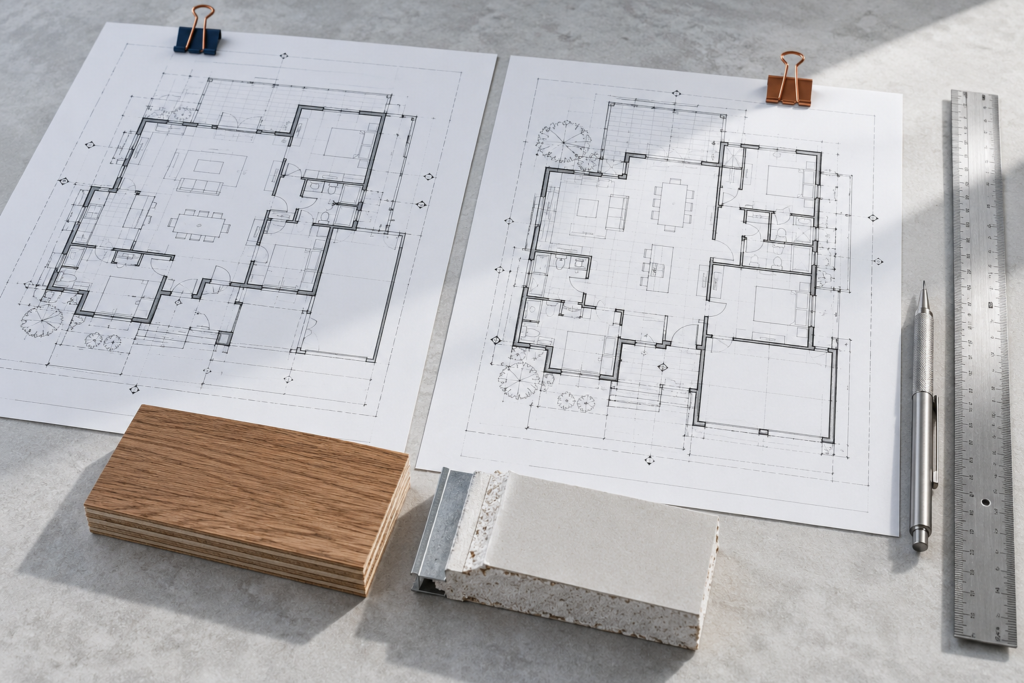
- Initial record and production-gap memorandum.
- Estimate comparison and quantified issue matrix.
- Expert-to-estimate recommendation crosswalk.
- Claim chronology tied to material documents and estimate versions.
- Written expert report, rebuttal analysis, or declaration within the defined scope.
- Deposition, mediation, arbitration, appraisal-related consulting, or trial support as appropriate to the retained role.
Expert credentials
Jeffrey S. Aal, A.I.C.
More than thirty years in property claims, including carrier, independent-adjusting, public-adjusting, consulting and litigation-support work.
Core work includes property claim scope, Xactimate estimating, repair valuation, contents documentation, claim financial analysis and claim-handling factual analysis within the defined assignment and his expertise.
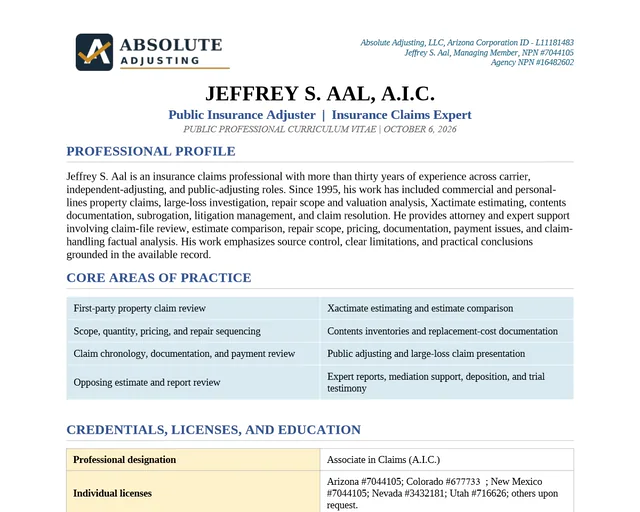
Public CV
Experience, practice areas, designation, licenses and education.
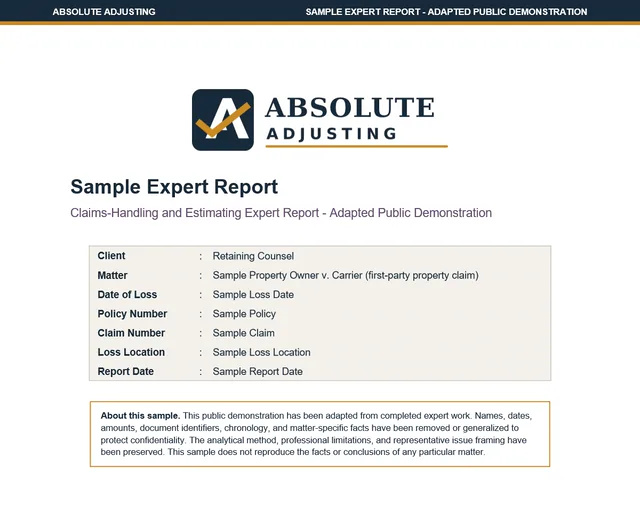
Sample expert report
Adapted public demonstration; matter-specific facts removed or generalized.
The assignment is defined before the opinion
 An expert assignment should begin with the issue to be addressed, the professional discipline involved, the intended use, the governing deadlines, and the materials expected to form the record. A broad request to “review the claim” is not a sufficiently controlled scope.
Absolute Adjusting works with counsel and other retaining professionals to distinguish technical estimate, construction, adjustment-practice, and claim-document questions from coverage interpretation and legal conclusions. Opinions are limited to the expert’s qualifications and the record actually reviewed.
Controlled expert intake
Conflict and role check
The parties, property, prior involvement, requested role, and potential conflicts are identified before substantive materials are accepted.
Assignment definition
The technical questions, deliverable, relevant disciplines, time period, intended audience, and exclusions are documented rather than left implicit.
Deadline control
Disclosure, report, rebuttal, deposition, inspection, and trial dates are confirmed with the retaining professional and tracked against the production schedule.
Production inventory
Each production is logged by source and date. File types, page or sheet counts, attachments, photographs, embedded material, and unreadable or inaccessible elements are identified.
Completeness reconciliation
Later productions are reconciled against prior inventories so new, duplicate, replaced, missing, or withdrawn materials can be distinguished and addressed.
Reliance record
The analysis identifies material reviewed and relied upon, material reviewed but not relied upon, unresolved gaps, and limitations created by unavailable evidence.
Expert findings must reconcile to the estimate
An engineering, environmental, building-science, or other expert report may materially affect the repair plan. The report alone does not establish that its recommendations were incorporated into an estimate. Absolute Adjusting can cross-reference each material recommendation against the proposed scope and classify it as included, partially included, omitted, contradicted, or unresolved.
The crosswalk can identify differences in demolition, access, cleaning, treatment, repair, replacement, testing, specialty-trade work, regulated-material interfaces, and construction sequencing. The purpose is not to substitute one discipline for another. It is to show whether the estimate reflects the expert record on which it appears to rely.
Where the estimated method conflicts with an expert recommendation, the report identifies the conflict and the resulting quantity or cost effect when it can be responsibly measured. Issues requiring clarification from the original expert remain questions, not assumed opinions.
For examples of this analytical approach, see why two estimates can differ even when both use Xactimate and how scope, quantity, price and methodology create different estimate disputes.
Independence and professional boundaries
Retention does not purchase a predetermined opinion. Conclusions may support, narrow, or contradict the retaining party’s initial theory. Alternative explanations and contrary evidence are addressed when they are material to the assignment.
Absolute Adjusting does not provide legal advice or decide insurance coverage. Counsel controls legal strategy, legal standards, disclosure requirements, and admissibility arguments. Other experts retain responsibility for opinions within their disciplines. No outcome, testimony result, or evidentiary ruling is guaranteed.
Frequently Asked Questions About Property Insurance Expert Witness Services
Jeffrey S. Aal, A.I.C., provides independent property-claim analysis and expert witness testimony in residential and commercial property insurance disputes. Common assignments include claim-handling practices, scope and repair estimate discrepancies, valuation disputes, appraisal-related issues, and reconstruction of claim timelines and financial records.
Absolute Adjusting accepts expert witness and litigation-support engagements from plaintiff-side insurance attorneys, defense counsel, and other retaining parties seeking an independent, source-traced technical review. Each engagement is evaluated for conflicts, jurisdiction, and subject-matter fit before acceptance.
While Arizona and Colorado are Absolute Adjusting’s primary markets, expert witness and consulting assignments are not restricted by state public-adjuster licensing boundaries. Jeffrey S. Aal is available for consultation, report preparation, deposition, and trial testimony across multiple jurisdictions depending on case requirements.
For an initial inquiry, retaining counsel should provide the names of the parties for a conflict check, the property location, the date of loss, the current litigation or claim posture, any known disclosure or discovery deadlines, and the specific question the assignment is intended to answer. Do not send confidential claim files or pleadings until conflicts are cleared and a formal engagement is confirmed.
A public adjuster represents and advocates for a policyholder directly against an insurance carrier during the adjustment of a claim. By contrast, an expert witness provides an objective, independent technical evaluation for counsel or the court—stating the assignment, source record reviewed, methodology, assumptions, and limitations plainly without acting as a claim advocate.
Begin with conflicts, scope, and deadlines.
For initial routing, identify the parties and known opposing firms, jurisdiction, and a brief description of the requested expert service. Include any known deadline. Detailed intake can follow the initial conflict and fit review. Do not send claim or litigation files through the public website.
For attorneys, insurers, property owners, and other retaining parties seeking expert analysis or testimony. Please provide only the information needed for initial routing. Do not send claim documents, confidential records, privileged material, Social Security numbers, payment information, or other sensitive personal information through this public form. Submitting this inquiry does not create an engagement or representation.