
Inventory Services
A defensible contents inventory begins with evidence, not a product search.
Room-organized personal-property inventories developed from photographs, records, and human review, with a traceable path from observed item to replacement research.
From field evidence to a usable claim workbook
Large-loss contents work is not merely data entry. The assignment begins by organizing the available photography and records, defining the rooms and source folders, and confirming what evidence is expected. The source set is then reconciled against the resulting workbook so photographed areas are not silently omitted.
Items are described in plain language suitable for like-kind-and-quality replacement research and connected to available photographic evidence. Installed building components are separated from personal property. Repeated views of the same item are reconciled to reduce duplicate entries, while grouped items are separated when the evidence permits responsible identification.
The controlled inventory process
1. Evidence intake
Photographs, room labels, prior lists, receipts, and supplemental detail images are inventoried. Gaps, inaccessible files, and ambiguous room routing are identified before final assembly.
2. Room-level extraction
Observed personal property is described room by room with quantity, condition, material, visible brand information, and photo references when the evidence supports those details.
3. Coverage reconciliation
Each source room with photographs must reconcile as extracted, expressly routed to another area, or deliberately excluded. An empty output is not treated as completed review.
4. Identity and duplicate review
Multiple views are checked for repeated items and boundary overlap. Brand, model, and quantity are recorded only when sufficiently supported rather than inferred from a blurred or partial image.
5. Replacement research
Ready items are researched against defensible retail comparables. Specialty, discontinued, unclear, or poorly documented property is held for additional review rather than forced into a weak match.
6. Final quality control
The workbook is reviewed for missing rooms, unsupported quantities, description quality, duplicate risk, link integrity, and pricing exceptions before it is presented as a completed deliverable.
Human review is part of the method
Structured tools can assist with organizing photographs, drafting descriptions, and researching candidate products. They do not eliminate professional judgment. A reviewer must still decide whether the evidence supports the item identity, quantity, condition, duplicate treatment, and proposed retail comparison.
Uncertainty remains visible. Items that cannot be responsibly identified or priced are flagged for follow-up, not disguised as completed work. This exception-based review is particularly important for specialty property, collections, custom items, incomplete views, and losses where photographs were taken primarily for documentation rather than inventory.
What the client receives
- A room-by-room workbook organized for review and claim use.
- Item descriptions developed for replacement research rather than generic category labels.
- Quantities, condition notes, visible brand information, and evidence references where supported.
- Replacement-research links and pricing support for items cleared for valuation.
- Explicit review flags for uncertain, specialty, duplicate-risk, or not-yet-priceable items.
- A documented record of source-area coverage and unresolved evidence gaps.
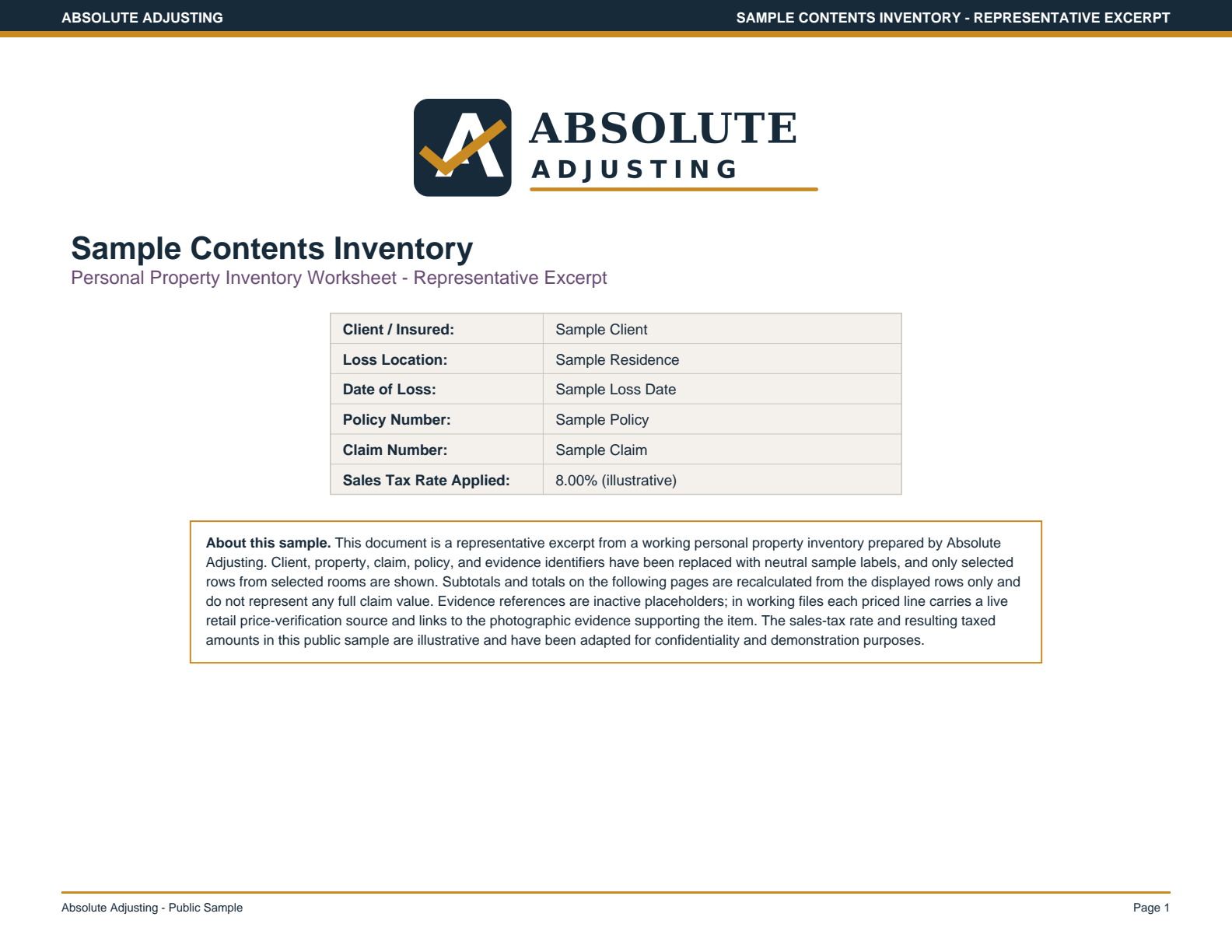
See a representative inventory excerpt
This seven-page public sample shows the room-by-room structure, evidence-reference fields, pricing status, and displayed-row totals. It is an excerpt for demonstration, not a complete claim valuation.
Appropriate assignments
Inventory services may support insureds, public adjusters, attorneys, experts, restoration professionals, and other claim participants who need an organized contents record. The appropriate scope depends on the size of the loss, quality of the source material, intended use, deadline, and whether valuation or expert testimony is contemplated.
For the valuation distinctions behind a contents schedule, read actual cash value, replacement cost and depreciation on a contents claim.
Fees are established after the source set and requested deliverable are understood. No public rate is quoted because a 200-item well-documented inventory and a multi-room fire loss with incomplete photography are not the same assignment.
Start with the size of the loss and the source material.
Describe the property, approximate inventory size, available photographs or records, current claim posture, intended use, and deadline. Do not send claim documents through the public website.
Website information is general and does not create a professional relationship, provide legal advice, determine insurance coverage, or promise a claim or litigation outcome.
For property owners, public adjusters, counsel, carriers, and other professionals seeking priced contents inventory services. Please provide only the information needed for initial routing. Do not send claim documents, confidential records, privileged material, Social Security numbers, payment information, or other sensitive personal information through this public form. Submitting this inquiry does not create an engagement or representation.