
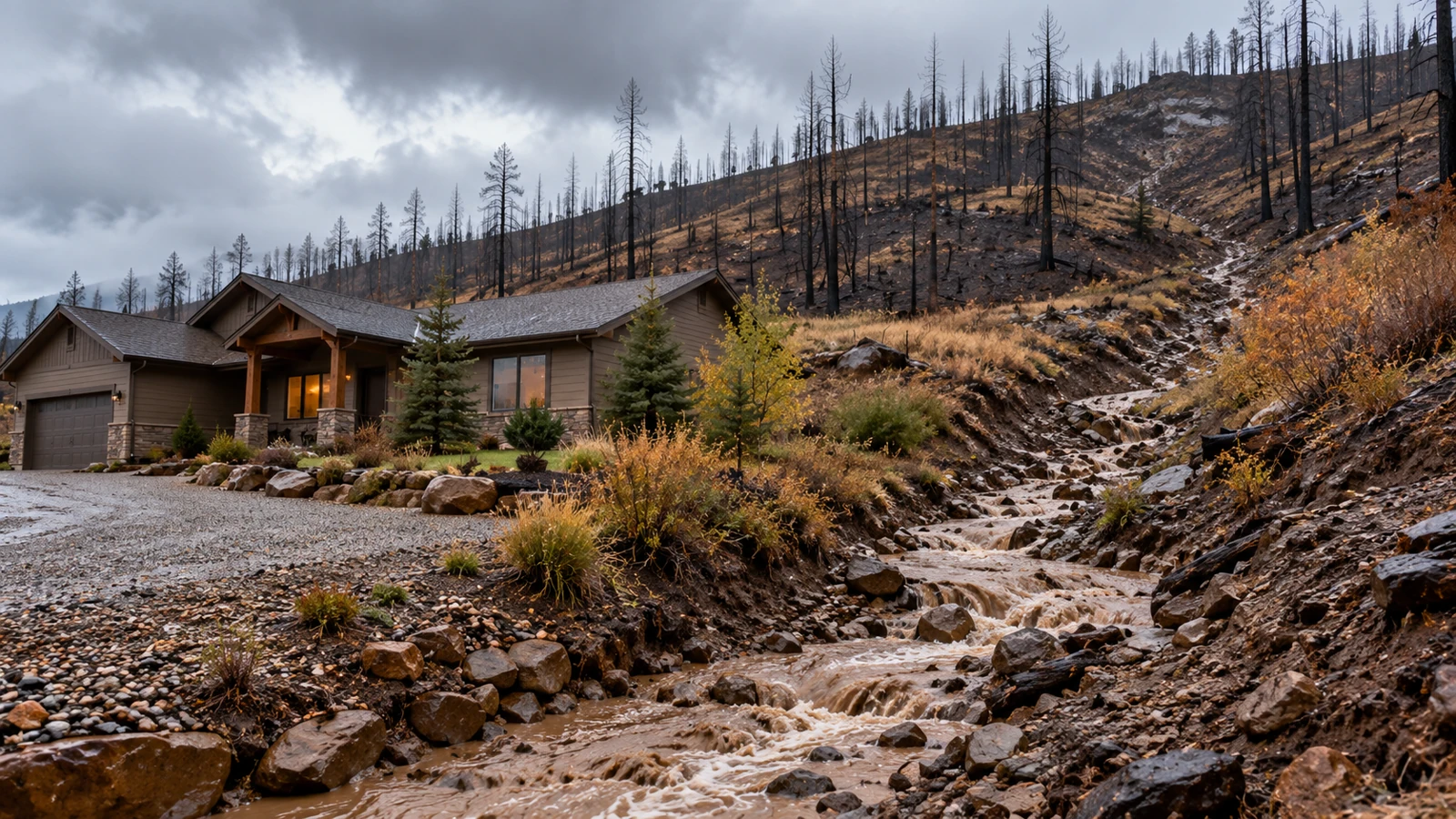
The flood risk can continue after the wildfire, and the insurance policy that responds may be different.
The flames may never reach a house, yet the hillside above it can change dramatically. After a wildfire, vegetation and ground cover may be lost, leaving slopes more vulnerable to rainfall runoff, erosion, flooding, and mudflow. A property owner who has focused on the fire may face a different danger when the next heavy rain arrives.
The distinction matters because fire insurance does not automatically cover flooding. Standard homeowners insurance typically excludes flood damage. A separate flood policy, specific endorsements, or another applicable policy may need to be evaluated before a loss occurs.
In July 2026, the Colorado Division of Insurance advised people living in or downstream of wildfire burn scars to consider flood insurance. Arizona insurance guidance also identifies burn scars as an important flood-risk consideration. These are warnings about exposure, not a finding that any particular property is uninsurable or that any future event will meet a policy definition.
Why a burned hillside can change the next storm
Vegetation can slow runoff and help stabilize soil. When wildfire removes ground cover, rain may move more quickly downhill, carrying sediment and debris. Risk can extend beyond the area actually burned, including downstream homes, roads and drainage features.
The risk to an individual property depends on terrain, burn severity, rainfall, drainage and other site conditions. A burned slope does not prove that a particular home will flood; a home outside the fire perimeter is not necessarily outside the potential runoff path. Property-specific assessments and local emergency information matter.
A homeowners policy and a flood policy answer different questions
A policy that responds to covered fire damage may not insure loss caused by surface flooding. The Consumer Financial Protection Bureau and insurance regulators explain that standard homeowners coverage generally excludes flooding. Property owners should review their declarations and endorsements rather than relying on a general statement that the house is insured.
Even the word "mud" does not answer the coverage question. The National Flood Insurance Program distinguishes qualifying mudflow from a landslide or other earth movement. Different causes and definitions can lead to different results. Whether a particular incident meets a policy definition depends on the actual facts and contract language, not a description taken from a photograph.
A licensed insurance agent can explain available flood products, eligibility, limits, and options for buildings and contents. A public adjuster reviews and presents a claim only within a separately accepted, authorized engagement; buying or changing flood insurance belongs with the appropriate agent or insurer.
Do not assume new flood insurance begins immediately
The National Flood Insurance Program generally imposes a 30-day waiting period before a new policy takes effect. Exceptions exist, including a narrowly defined post-wildfire provision, but they depend on the specific circumstances. An owner should not rely on an exception to close a last-minute coverage gap. Confirm the effective date in writing.
FloodSmart.gov now offers an online path to obtain a National Flood Insurance Program quote and, where eligible, purchase coverage, alongside the established agent route. The quote, purchase, effective date, and available coverage are separate steps. An online confirmation should be retained with the policy record.
What owners can do before the next storm
Review the current insurance file for the property, including the declarations, any flood policy, endorsements, deductibles, limits, and effective dates. Identify which buildings and contents are scheduled and whether additional structures or business property require separate consideration.
Preserve dated exterior photographs from safe locations, a basic property inventory, and existing repair records. Review local emergency notifications and published flood-risk information. If a property lies below a burn scar, consult the appropriate public authority or a qualified specialist about drainage and protective measures. Do not undertake grading or stream alterations without the required professional and governmental direction.
Property managers and association boards should confirm which entity is insured, who can authorize insurance decisions, which common elements are involved, and how individual unit-owner policies may differ. The governing documents and insurance contracts require separate review; a management agreement alone should not be assumed to resolve those questions.
If water or mud reaches the property
Prioritize personal safety, follow evacuation instructions, and avoid entering floodwater or unstable areas. Report the event promptly through the appropriate insurance channels. When more than one policy could apply, preserve each notice and the response, without assuming that one notice satisfies another policy.
When it is safe, photograph observable conditions before they change, record the date and location of water entry, preserve weather alerts and public incident information, and keep receipts for reasonable emergency protection. Separate observations from interpretations: a photograph may show deposited sediment without proving whether the mechanism was a flood, mudflow, slope failure, or another cause.
Seek clarification from qualified professionals when the cause, extent, or repair method is disputed. A supportable estimate may require separate treatment of removal, cleaning, structural work, contents, equipment, access, and specialist testing. Coverage remains a distinct question governed by the operative policy and applicable law.
The useful decision happens before the loss
The most effective time to evaluate the flood-coverage gap is before a weather event. A professional conversation with an insurance agent may reveal the need for a separate policy or a waiting period that cannot be shortened at the last moment. After a loss, sound claim documentation helps identify what occurred and what the relevant insurer has accepted, disputed, or not yet addressed.
Absolute Adjusting provides public adjusting where authorized and appropriate, and defined claim consulting or estimate analysis for property owners with substantial documentation and scope questions. We do not sell insurance or direct, select, or recommend contractors. An initial inquiry can help define the requested claim-related role without sending confidential claim documents through the website.
General education only. This article does not determine flood risk at a specific address, interpret an individual policy, provide legal advice, or guarantee coverage or a claim outcome. Consult the insurer or a licensed insurance agent about coverage, and qualified counsel about legal questions.
Further reading: Colorado DOI | Arizona DIFI | NFIP waiting period | NFIP mudflow guidance | NFIP quote tool