
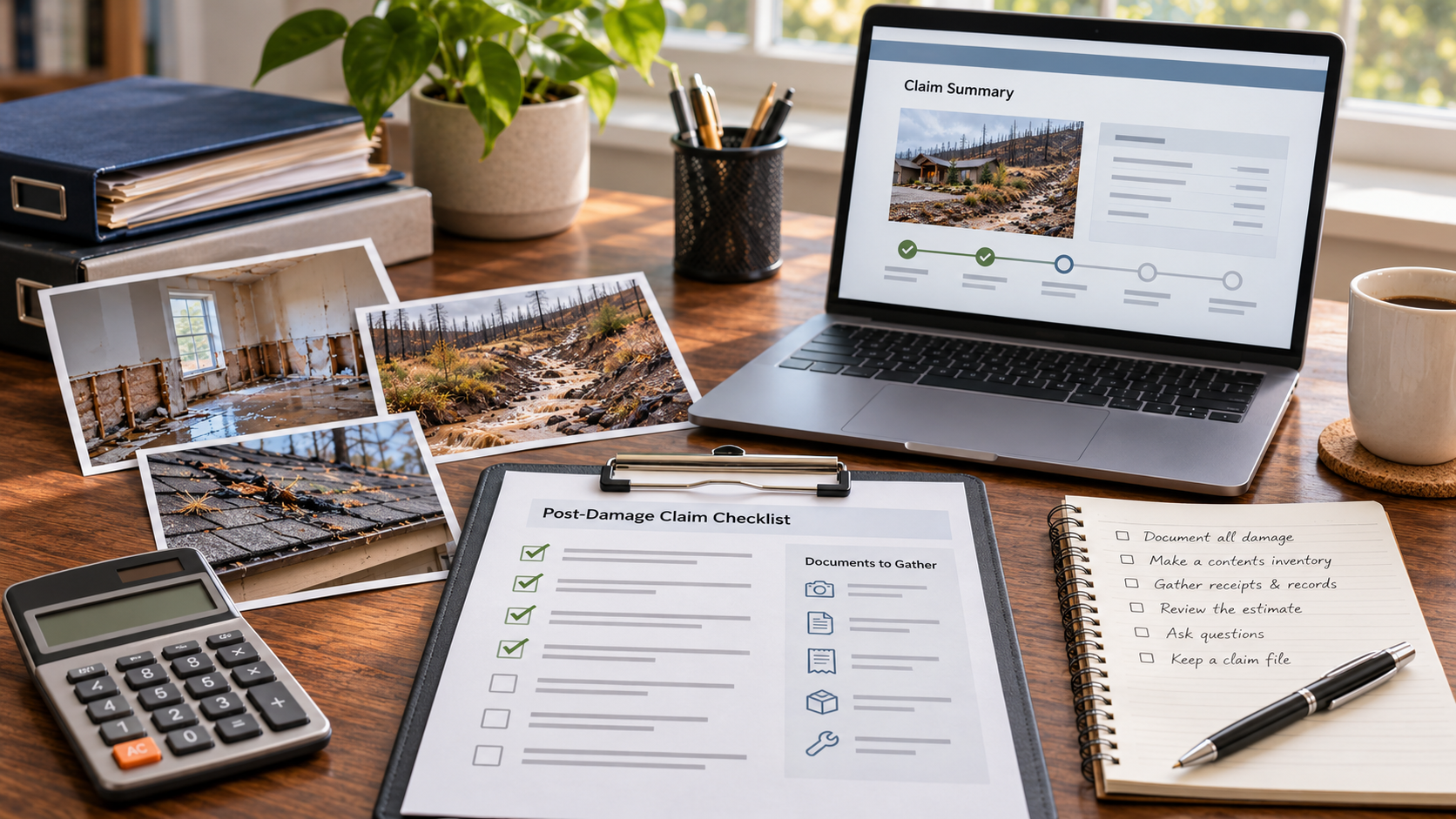
An organized claim record helps property owners understand what has happened, what remains unanswered, and what evidence is needed next.
A kitchen fire, a broken supply line, a severe windstorm, or a tornado can change a property owner's priorities in minutes. Safety, temporary protection, damaged possessions, displaced occupants, and interrupted operations take precedence. Insurance paperwork arrives at the same time, often before anyone knows the full extent of the damage.
A property claim is not simply a photograph of a damaged building followed by a repair estimate and a check. It may involve separate inspections, emergency services, building estimates, contents records, specialized evaluations, payment transactions, and policy-dependent decisions. The people producing those records may be doing different jobs, and their documents do not always answer the same questions.
The most useful early objective is not to predict the final settlement. It is to preserve reliable evidence and create a record that lets you answer each important question. Seven practical areas deserve attention.
1. Start with safety, then establish the claim's basic facts
Protect people before property. Follow emergency officials' instructions, stay out of unsafe structures, and do not enter areas affected by unstable framing, exposed electrical systems, contaminated water, or other hazards until qualified personnel determine they can be entered safely. Do not delay emergency action for photographs.
Notify the insurer or agent through the appropriate reporting channel within the requirements of the policy and applicable circumstances. The first report should be factual: the location, the approximate time the damage was discovered, what was observed, and any immediate steps taken. The cause may not yet be known. Don't guess at a cause that requires later inspection or expert analysis.
Record the claim number, the insurer's contact information, the assigned representative's name or role, and any immediate documentation requests. Ask whether the policy requires a sworn proof of loss, special forms, or other time-sensitive submissions. Do not assume that the carrier's ordinary workflow replaces a deadline stated in the contract.
If the policy is not readily available, request the applicable declarations, forms, and endorsements. Coverage questions cannot be reliably resolved from a general description of what a homeowners or commercial policy usually includes.
2. Document the condition before it changes, without delaying necessary protection
When safe, photograph and video the overall property and the individual affected areas. Start with wide views that show where the damage is located, then capture close-ups of materials, equipment, finishes, personal property, and other details. Include unaffected adjoining areas when they provide useful context. Retain the original image and video files rather than relying only on screenshots, edited photographs, or files embedded in a report.
Document water lines, openings, debris locations, visible residue, displaced contents, and conditions that may change once drying, demolition, cleaning, or reconstruction begins. For a roof or exterior loss, photographs should establish the location and condition of the actual affected components, not merely the appearance of a finished replacement.
Take reasonable, safe measures to prevent further damage. Those measures may include emergency boarding, temporary weather protection, water extraction, or protection of exposed property. Keep service tickets, photographs, work authorizations, invoices, and receipts. If conditions must be altered immediately to address safety or prevent additional damage, document what you can safely and explain why the work could not wait.
Do not assume that every item must be retained indefinitely. Some property may be unsafe or impractical to store. Before disposal, when safe and practicable, ask the insurer what inspection or documentation it requires, preserve identifying information, and record the disposition. Emergency disposal decisions and ordinary cleanup decisions may require different handling.
3. Maintain one claim record, with dates and unresolved questions
Important information quickly becomes scattered among emails, text messages, contractor proposals, invoices, insurer portals, and telephone conversations. A useful claim file preserves the originals and makes the chronology understandable.
Keep the policy and endorsements, initial notice, claim number, photographs, inventories, estimates, expert reports, contracts, communications, invoices, payment records, and documents showing work completed. For substantial files, retain each estimate and inventory version with its date and stated preparer. Do not replace an old version merely because a newer one has arrived.
For material calls, record the date, participants, subjects discussed, commitments, and outstanding questions. A brief confirmation of an important decision can help avoid confusion later. When a document arrives, record what it actually answers, not just that you received something.
An outstanding-issues register can be very simple. Identify the question, who is expected to answer it, the last meaningful request or response, the source of the answer, and any verified deadline. Mark an item answered only when the received information actually resolves it. The purpose is to prevent omissions, not to send repetitive inquiries every few days.
Separate verified observations from the owner's recollection, a contractor's assumption, an adjuster's preliminary position, and a qualified specialist's opinion. All may be relevant, but they are not interchangeable forms of evidence.
4. Understand what a repair estimate does, and does not, establish
An insurance estimate is a proposed measurement and valuation of particular work. It is not automatically a complete construction contract or proof that repairs can be completed for the displayed total. A contractor's proposal may have exclusions, allowances, deposit requirements, or work that has not yet been priced. An insurer's estimate may address only the work it currently recognizes.
Compare descriptions and operations before comparing totals. For building repairs, review the affected rooms and components, removal and disposal, access and protection, material selection, quantities, labor, equipment, sequencing, and the proposed repair method. The difference between cleaning, repair, and replacement matters only when the chosen method is supported, and all necessary operations are included.
Likewise, a code-upgrade item requires a traceable basis. A proposal should identify the applicable requirement, the existing condition, and why the proposed work is triggered. Whether the policy pays for ordinance-or-law work is a separate contract question. A contractor's statement that something is 'code' does not, by itself, establish either the requirement or the coverage.
Technical reports also have limits. A structural engineer may address load-bearing repairs without determining smoke-residue treatment. A restoration professional may describe cleaning procedures without establishing structural capacity. If a report recommends an additional inspection or testing, the estimate should account for the decision point rather than pretending that the unseen condition has already been resolved. The objective is not to choose the largest estimate. It is to establish a supportable scope and pricing basis for the work actually needed, while identifying genuine exclusions, allowances, and unresolved conditions.
5. Build a contents inventory that distinguishes what is known from what is missing
Photographs can establish the presence of belongings, but they rarely show every item in a drawer, closet, cabinet, storage room, garage, or outbuilding. Begin with a room-by-room record. Describe the item, quantity, location, known brand or model, condition, and available supporting source. Mark uncertain information as uncertain rather than selecting a convenient replacement description or price.
Restoration vendors may create pack-out records, box labels, warehouse listings, cleaning records, or custody logs. Those documents can establish what the vendor handled and where it went. They are not necessarily a complete priced inventory of every damaged or missing possession.
Care is required when reconciling photographs and lists. The same chair may appear in three images, while one line reading 'assorted tools' may represent many separate objects. Similar descriptions do not always prove duplication, and differing descriptions do not always prove different property. Document the identity decision before adding or deleting an item.
When pricing is needed, compare the documented item's relevant characteristics to a reasonably comparable replacement, retaining the source and date of the research where available. Do not confuse a retail search result with proof that the item was owned, damaged, covered, or worth that amount under the policy. Replacement-price research and depreciation are different questions.
If the original inventory was destroyed, use other evidence: older photographs, receipts, email purchase confirmations, manuals, household records, and information from people familiar with the property. The record can remain useful while identifying missing rooms, unsupported identifications, and items requiring owner review.
6. Reconcile the valuation and every payment separately
A carrier's repair estimate, a replacement-cost value, an actual-cash-value calculation, and the amount of an issued check are not the same figure. Replacement cost generally addresses the cost of repairing or replacing property with like kind and quality under the applicable policy. Actual cash value commonly reflects depreciation or other valuation rules, depending on the contract and jurisdiction. A deductible, limits, prior payments, or withheld depreciation may further affect what is currently payable.
On a significant loss, money may move through different channels. A check may be issued but never received; received but not negotiated; negotiated but controlled by a mortgage lender; or paid directly to a mitigation company or other vendor. Funds held by a lender are not automatically available for a contractor deposit. An estimated line item also does not prove that money for that work has been disbursed.
Request or maintain an itemized payment history identifying the coverage, payee, date, amount, instrument, stated purpose, and any reversal or reissue. Separate building payments from contents, temporary housing, and vendor-direct transactions. Track recoverable depreciation and costs payable only when incurred as their own categories. Where a check has expired, been replaced, or requires lender endorsement, document its actual status.
This accounting is particularly important when choosing a contractor. Evaluate a proposed repair price against the supported scope and contract terms, and identify available construction funds separately. The two numbers may differ substantially, and treating them as interchangeable can create an obligation the owner does not have money available to meet.
7. Address temporary housing, operations, and decisions that cannot wait
A home may be uninhabitable while the claim and reconstruction continue. If the policy provides additional living expense coverage, determine what expenses are eligible, what approvals or limits apply, and what documentation the insurer needs. An outside housing proposal, a lease extension, or a quoted monthly rent is not automatically authorized merely because the dwelling remains damaged.
Record the current lease end date, its written notice provisions, any deposit or cancellation exposure, and the terms of a proposed alternative. Keep housing receipts and identify who pays the provider. When time permits, ask the insurer for its written position before taking on substantial new obligations. If the notice deadline will arrive first, make that deadline explicit rather than waiting for an ordinary claim review.
Businesses, churches, and other organizations face different questions. Their policies may address business income, extra expense, equipment, stock, or interruption of operations, depending on the specific forms and conditions. Ordinary household living-expense provisions should not be applied to commercial or nonprofit losses without examining the contract.
Longer claims benefit from a controlled follow-up schedule. The right question is not 'Have you heard anything?' every few days. It is whether a prior commitment, requested document, policy obligation, lease date, safety concern, or other event now requires action. Record completed requests so they are not sent again simply because a diary reminder has appeared.
When independent professional review may be useful
Most policyholders can complete the first steps themselves. A licensed public adjuster may help when the scope or quantities remain unclear, contents documentation is substantial, estimates cannot be reconciled, or payment accounting is difficult to follow. A qualified contractor or technical specialist addresses construction feasibility or specialized conditions. Counsel addresses legal interpretation and litigation decisions. Do not confuse these roles, and start by defining each professional's assignment.
A sound review may confirm that the insurer or contractor was correct about some items and wrong or incomplete about others. The goal is not a predetermined higher number. It is a documented, defensible understanding of the claim, the remaining disagreement, and the next action needed to resolve it.
The bottom line
After property damage, the most valuable file is not necessarily the thickest one. It is the file that preserves original evidence, distinguishes estimates from payments, keeps uncertain facts identified as uncertain, and makes outstanding decisions visible. That record helps the property owner, insurer, contractors, and other professionals address the actual remaining questions instead of repeatedly revisiting the same history.
Absolute Adjusting provides independent public adjusting and defined claim-analysis services, subject to licensing, jurisdiction, conflicts, and engagement scope. This article is general education, not a coverage determination or legal advice. The operative policy, actual loss facts, and applicable law control.
Sources and further reading
Absolute Adjusting, Claims Intake: What Happens Between the First Call and the Adjuster