
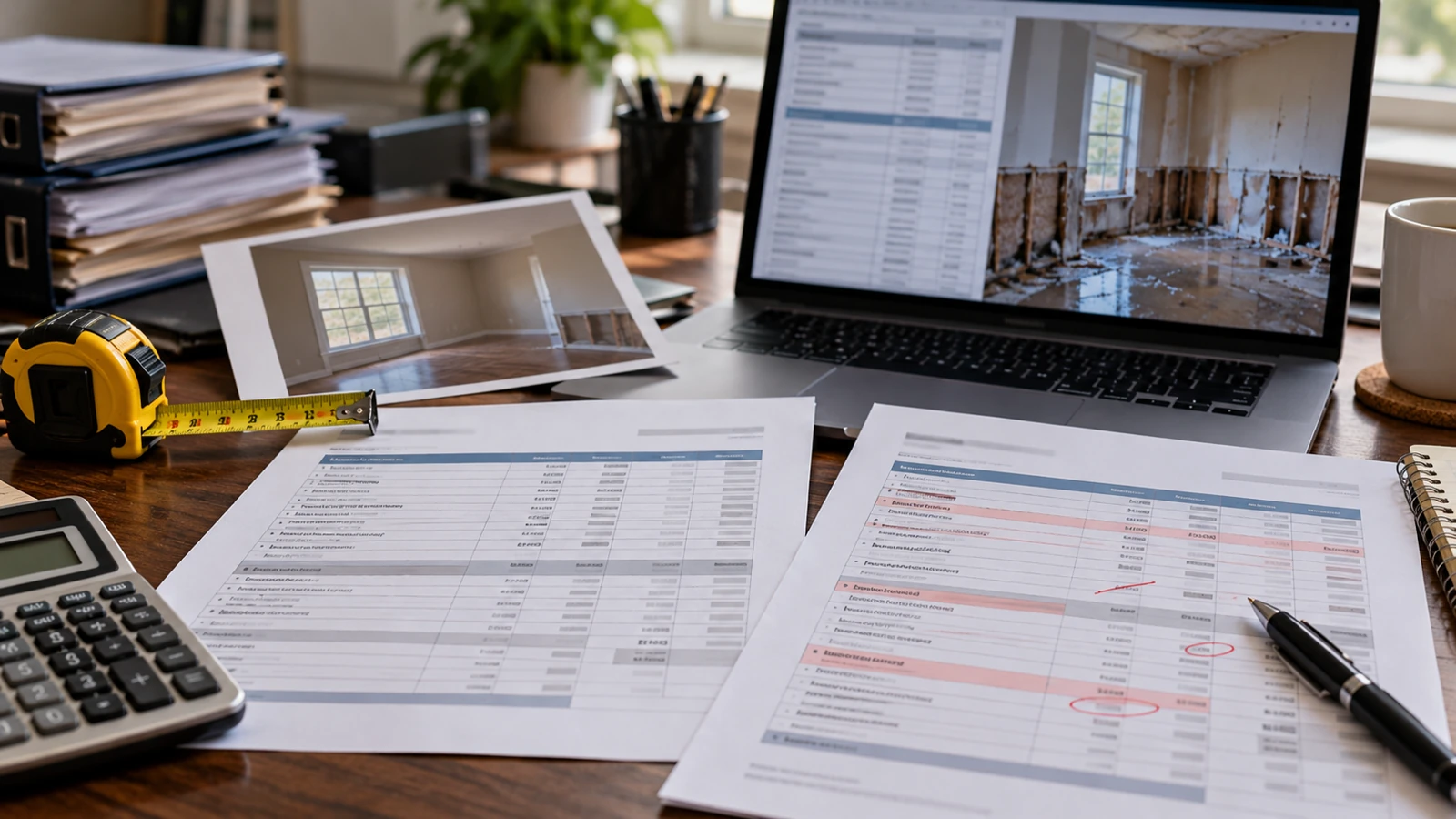
How to trace changes in building and contents valuations instead of comparing bottom-line totals.
An adjuster inspects the damage or reviews a contents inventory. An estimate is prepared. Later, another version arrives with a lower total. For the property owner, the immediate question is understandable: what happened to the amount that was there before?
The useful answer requires identifying what changed, why it changed, and whether the revised amount still accounts for the work or property being evaluated.
Professional review of insurance estimates can reveal material changes after a desk review, involving building repair operations, personal-property descriptions, quantities or valuation. This is an issue worth examining on the facts of the particular claim, not evidence of how often reductions occur across the insurance industry.
Desk review can improve an estimate
A review may correct a measurement, remove a genuine duplicate, identify an incorrect product, or incorporate new evidence. The field estimate is not automatically correct because its author visited the property. A desk reviewer may identify an error without repeating the inspection.
However, the title of the reviewer does not establish that a revision is sound. A material reduction should be traceable to an identifiable correction, supported judgment, or separately explained coverage decision. “Reviewed and adjusted” provides little help when the disputed work or property remains unexplained.
First establish what was reduced
Compare equivalent figures before drawing conclusions. Replacement cost value generally measures repair or replacement using like-kind-and-quality materials or property. Actual cash value considers depreciation. A payment may also reflect a deductible, prior payments, limits, or other policy provisions. The NAIC explains the basic valuation distinction in its consumer guidance.
A lower check does not necessarily mean the estimate was reduced. Separate the underlying valuation from the amount currently payable. Then make two comparisons: the earlier estimate against its revision, and each estimate against the supported repair or replacement requirements. The amount removed may not represent the full extent of any remaining deficiency.
For building repairs, trace the changed work
Compare the estimates by room, component, and repair operation, not just their final totals. Look for work removed altogether, smaller quantities, different materials, changed unit prices, and substitutions of cleaning or repair for replacement.
Then ask what supports each material change. Was a measurement corrected? Does a photograph establish a different condition? Did a qualified specialist identify a workable repair method? Was necessary access, protection, removal, or reinstallation omitted when another operation was deleted?
A change from replacement to repair or reuse raises two questions. Is that approach supported? Even if it is, does the revised estimate include the operations needed to complete it? Costing an alternative does not establish that it is technically suitable. Structural or environmental questions may require the appropriate specialist. Restoring deleted entries alone may also leave earlier omissions unresolved.
For contents, trace each item and its replacement
Contents reductions can be harder to follow because descriptions, quantities, retail references, and depreciation may change at the same time. Preserve the connection between each inventory line, its photographs or other supporting records, and the proposed replacement product.
Check whether a substituted comparable reasonably matches the documented item’s material, quality, size, and relevant features. A less expensive product may be appropriate, but its lower price does not establish comparability. Review quantities as well: a set, a pair, and a single item are not interchangeable units.
Duplicate removal also needs support. Similar descriptions can represent separate possessions in different rooms. Conversely, different descriptions can refer to the same item. Resolve the identification before deleting value.
Keep replacement pricing separate from age, condition, and depreciation assumptions. If an item changes from replacement to cleaning or salvage, identify the condition evidence and technical basis for that decision. An unsupported age or product substitution can change the result without resolving what was actually lost.
Build a record that explains the difference
Keep each available estimate or inventory version in its original form. Record its date and identified preparer, and preserve the correspondence accompanying it. A name remaining on a revised document does not, by itself, establish who made every change.
Record the original entry, revised entry, dollar effect, explanation, and supporting evidence. Separate confirmed facts from assumptions and provisional allowances. A disputed item carried at zero remains unresolved unless evidence supports excluding it.
Group equivalent work before calculating differences. An entry missing from one room may have moved elsewhere or been included in a broader allowance. Reconcile the groups to the total, accounting for tax and applicable overhead and profit once. Check pricing dates and locations. Recognize supported decreases as well as increases.
Request clarification about specific entries. Identify the document, room or item, changed operation or value, and the unanswered question. That gives the reviewer something concrete to address and helps counsel or a technical expert distinguish a valuation disagreement from a coverage or legal issue.
The explanation matters as much as the total
An unsupported reduction can leave necessary repair work unfunded, substitute unsuitable replacement property, or shift an unresolved gap to the owner. The consequence is practical, not merely a smaller number on a spreadsheet.
The objective is an accurate, supported evaluation, not automatic acceptance of the highest estimate. A reduction can be justified. An unexplained reduction deserves examination. For building repairs and contents alike, preserve the history and test the revised result against the evidence.
Absolute Adjusting provides property-claim analysis, estimate and contents review, and expert-witness support for defined assignments. This article offers general educational guidance for Arizona and Colorado readers. Policy terms, facts, and applicable law control; legal interpretation and advice belong with qualified counsel.
Further reading: NAIC cash value and replacement cost