
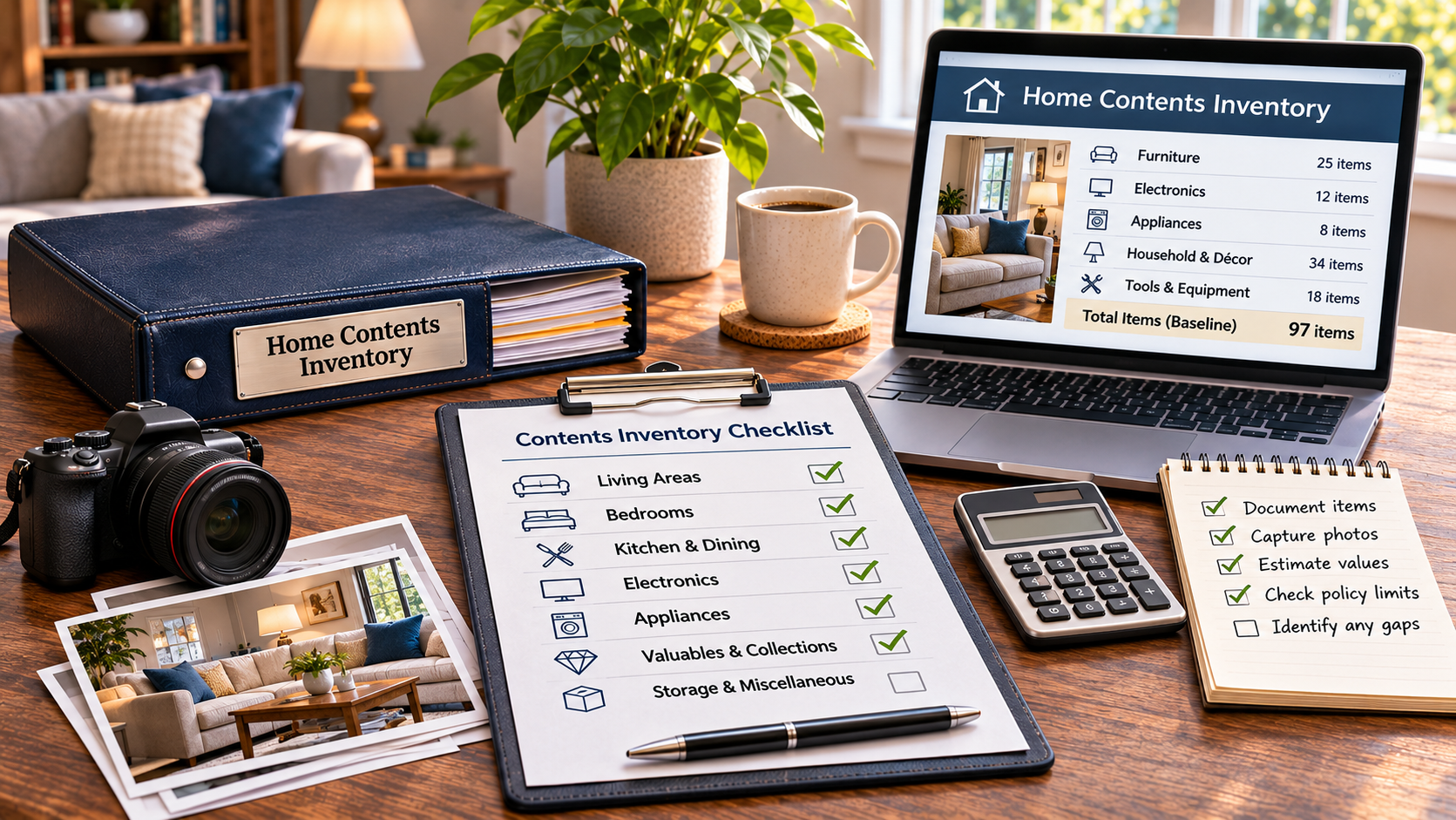
Pre-loss inventories help assess personal-property limits. AI-generated concept image; no actual insured property or client data.
A personal-property coverage limit is not a tally of what is in your house. A useful inventory can show whether the two deserve a closer look.
You probably know what your home is insured for, but could you estimate a reasonable replacement cost for the clothing, furniture, cookware, electronics, tools, hobby equipment, and possessions stored in every closet and cabinet? Many homeowners cannot, especially without a written inventory.
That matters before a fire, theft, or other major loss. Dwelling coverage is intended to cover the building, while the personal-property limit, often called Coverage C, is a separate figure. A policy’s age or a routine renewal increase doesn’t show that the contents limit matches what the household owns today.
Coverage C is a policy limit, not a household inventory
Personal-property coverage on homeowners policies is often expressed as a percentage of the dwelling limit. The Insurance Information Institute reports a common range of approximately 50% to 70%. The actual percentage, limit, valuation conditions, and exclusions depend on the specific policy. Some property forms use different structures altogether.
Consider an illustration: a home with $600,000 in dwelling coverage might carry $300,000 in personal-property coverage at 50%, or $420,000 at 70%. The difference is $120,000 in stated insurance limits. This does not mean the homeowner owns $420,000 in belongings, nor does it mean either policy would pay its full limit after a loss. Seventy percent can be a useful comparison point, but it is not a universal minimum or an assurance of adequate insurance. The defensible starting question is what the household actually owns and what it would reasonably cost to replace, followed by a review of the policy that is supposed to cover it.
What is hiding in the closets, cabinets, and garage?
The couch and television are easy to remember. It’s harder to account for everything in the kitchen, the clothing in several bedrooms, bedding, small appliances, tools, sports gear, seasonal decorations, hobby supplies, and items tucked away in boxes. A workshop, barn, detached garage, or home office may raise additional questions about how property is classified and covered.
These possessions accumulate over years. Some were gifts, inherited, purchased secondhand, or acquired before digital receipts became common. A household can be materially underdocumented even when every room has been photographed. Property that is not visible in a photograph may still have existed; likewise, an item should not be listed twice simply because it appears in different pictures.
Replacement cost, actual cash value, and special limits are different issues
Contents limits are only one part of a coverage analysis. A policy may settle eligible property at actual cash value, which reflects depreciation, or provide replacement-cost coverage subject to stated conditions. Some replacement-cost forms require purchases and supporting receipts before paying additional amounts. A complete inventory does not alter these provisions.
Certain categories may also have special dollar limits, especially for specific causes of loss. Jewelry, collections, cash, business property, and equipment used away from the residence deserve careful attention. Scheduled-property coverage or an endorsement may be available, but the circumstances and cost should be discussed with a licensed insurance agent.
This is why comparing a total inventory estimate with the Coverage C declarations number is helpful but not sufficient by itself. Exclusions, sublimits, deductibles, eligibility, and loss-settlement terms can affect the actual protection.
Begin with a room-by-room record, not a perfect spreadsheet
A practical baseline starts with a walkthrough. Photograph the room as a whole, then document shelves, drawers, closets, cabinets, garage storage, and other areas that an overview photograph obscures. Work when the home is safe and accessible. You do not need to complete an entire household in one sitting. For identifiable items, record the description, approximate quantity, location, and any available manufacturer, model, size, or serial number. Add purchase information, receipts, and photographs where available. Mark uncertain details as uncertain rather than inventing them. For multiples and sets, specify the counting unit so a box of dishes or a tool collection is not inadvertently counted twice.
A video walkthrough is useful, but it is not a substitute for knowing what was in a closed drawer or which model was on the shelf. The National Association of Insurance Commissioners recommends organizing inventories by room or category, with photographs and supporting purchase records when available.
Keep a separate copy outside your home, and treat the information as private. Household photos may reveal possessions, addresses, security details, and sometimes embedded location data. Update the record after major purchases, renovations, or other household changes.
Use the inventory to ask better insurance questions
Once you have a reasonable baseline, compare the supported replacement-value estimate with the actual Coverage C limit listed on your declarations. Treat unknown or unpriced items as an acknowledged gap rather than assigning them a value of zero. Then ask the insurer or a licensed agent to explain the available limit and loss-settlement options.
- What is my actual personal-property limit, and how was it selected?
- Does the policy settle belongings at replacement cost or actual cash value, and what conditions apply?
- What special limits, exclusions, or off-premises restrictions affect my particular belongings?
- Are expensive collections, business equipment, tools, or unusual property adequately addressed by the existing form?
- If the inventory suggests a mismatch, what higher limits or scheduled endorsements are available, and at what cost?
The goal is not to automatically buy the highest number. It is to understand the property, the available insurance, and the trade-offs before an event forces those questions into a claim.
Where professional inventory assistance may help
Some homeowners can create a useful pre-loss list on their own. Others have extensive collections, multiple storage locations, unusually large households, or incomplete records. Absolute Adjusting is developing separately scoped contents services, from a limited coverage-readiness review to more detailed inventory organization and replacement-cost research. These are distinct assignments with different scopes of work and pricing. Any detailed research, links to photographic evidence, and revisions must be defined before a fee is agreed.
A professional inventory can help organize what was identified, the quantities documented, the sources consulted, and the questions that still require the owner's answers. It does not guarantee coverage, establish ownership of every item, or substitute for the operative insurance policy. A preliminary pre-loss inventory is not the same as a fully supported, claim-ready damage valuation.
The best time to start is while the belongings are still there
Documenting your personal property is useful even if you never purchase professional services. Start with the rooms and items you know, preserve the original photographs, and build a record that can be updated. Then compare the inventory with your policy before the next renewal, not after a catastrophe.
For a defined contents inventory or valuation assignment, Absolute Adjusting can review whether professional assistance is appropriate. Start with a general inquiry rather than sending private photographs or household records through a public contact form. A separate scope and a secure document exchange method can be arranged when appropriate.
Sources and further reading
NAIC: Home Inventory | NAIC: Homeowners Insurance | Insurance Information Institute: Proper Disaster Coverage
General education only. Policy language and applicable law control. A personal-property inventory or estimated replacement value is not a coverage determination, proof of ownership of every listed item, or a guarantee of settlement.