
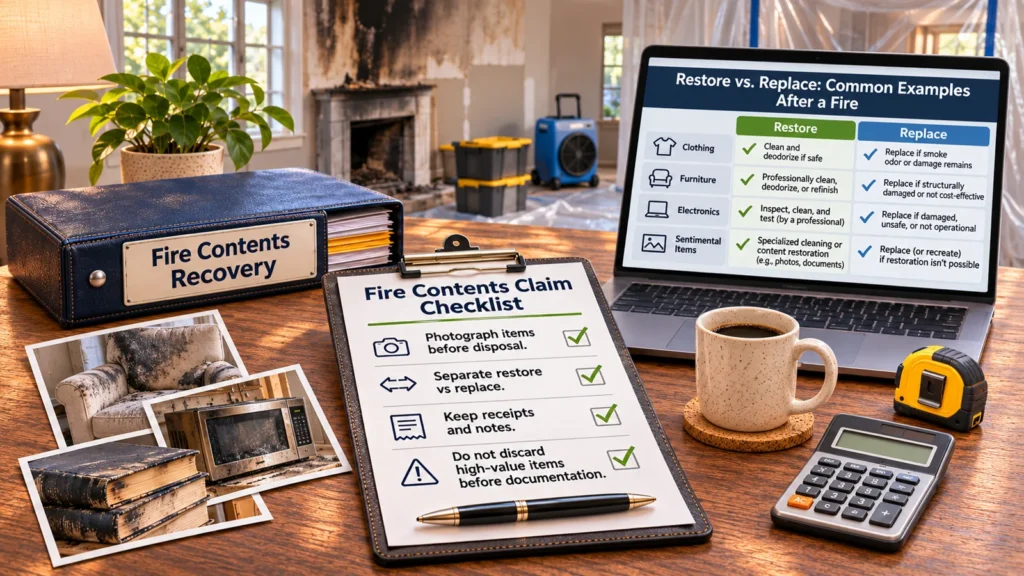
Cleaning, replacement, and disposal are different decisions. Homeowners should understand what is being proposed and what happens to their property before work begins.
The immediate answer
After a fire, decisions about belongings can come quickly. A contents contractor may recommend packing items for cleaning, separating unsalvageable property, or disposing of damaged materials. Those recommendations merit attention, but a visible layer of soot does not prove that everything is ruined. Nor does an item that looks clean prove it has been restored. A sound decision considers what the item is made of, how it was affected, whether it can be restored to its intended use, and the cost of complete restoration compared with an appropriate replacement. The owner should understand the recommendation, the uncertainties, and the plan for documenting each item.
What does “restored” actually mean?
The answer depends on the property. A cleaned dining chair must still be stable and usable. Clothing must be suitable to wear. An electrical appliance needs more than a wiped exterior; its safety and operation may require qualified evaluation before use. A family photograph, by contrast, may be worth preserving even if it cannot be restored to its original appearance. That distinction matters when someone offers to “clean everything.” Surface appearance, odor, function, material condition, and safe use are separate questions. Ask what outcome is expected, what damage may remain, and how success will be determined.
Different materials, different results
Heat, smoke residue, firefighting water, and physical damage can affect the same room in different ways. A hard, nonporous object may be a reasonable candidate for cleaning; a heat-distorted plastic part cannot be repaired simply by removing residue. Solid wood furniture and composite materials may respond differently to moisture, heat, or cleaning. Upholstered furniture includes fabric, padding, structure, and sometimes electrical components, not just an outer surface. There is no reliable restore-or-replace answer based solely on an item category. Uncertain or valuable articles may warrant controlled evaluation or a specialist. Artwork, antiques, photographs, electronics, and other unusual property can call for expertise beyond an ordinary contents-cleaning operation. Do not spend $15 restoring a $5 pair of socks. Restoration needs to make practical and economic sense. Whether an item should be cleaned or replaced is one question. How the insurance policy values that loss is another.
Cost matters, but it is not the only consideration
Restoration cost should reflect the entire proposed process, not just a quoted cleaning price. Pack-out, handling, transportation, storage, cleaning, specialty treatment, testing, repairs, and return delivery may all affect the comparison. Replacement should be compared with a reasonably equivalent item, with the necessary associated costs identified, rather than with an unrelated bargain price. An item may be technically restorable but uneconomical to restore. Conversely, a family keepsake may justify specialist attention even when its market price is modest. Sentimental importance warrants a conversation with the owner, but it does not automatically determine how much an insurance policy will pay. Keep the restoration decision and the insurance valuation separate.
Document belongings before they disappear
Before a pack-out or disposal, photograph the rooms and the larger or more significant items. For disputed or high-value property, record the description, observable condition, brand or model (when available), and the location where it was found. Request a written list showing what is being removed, where it will be stored, which items are proposed for restoration, and which are proposed for disposal. Save estimates, photographs, invoices, receipts, and any written authorization. A recommendation to replace an item is not, by itself, permission to discard it. Confirm the owner’s authorization and any insurer inspection or documentation requirements before nonurgent disposal. When a condition poses a safety or health hazard, follow qualified safety instructions and document the removal as safely as circumstances allow. Do not retain dangerous property merely to improve a claim file.
Questions to settle before authorizing work
Ask the contents contractor which items will be evaluated individually, whether cleaning tests are appropriate, what the estimated costs cover, and how an unsuccessful restoration will be handled. Confirm who is responsible for storage charges, how belongings will be tracked, and what records the homeowner will receive. A professional recommendation should identify what can reasonably be accomplished rather than simply assigning everything to a “restore” or “replace” column. The insurance company must still evaluate the claim under the policy. Whether restoration or replacement is covered, and the applicable valuation method, depreciation, deductibles, special limits, and payment timing depend on the specific policy and the facts of the loss. A contractor’s recommendation informs the process; it does not rewrite those terms.
The bottom line
The objective is not to save every item or replace everything. It is to make an informed decision, preserve what can reasonably and safely be restored, document property that cannot be restored, and avoid losing the information needed to support the claim. A little organization before items leave the house can prevent a much larger problem later.
Frequently Asked Questions About Cleaning vs. Replacing Fire-Damaged Belongings
A sound restore-or-replace decision depends on the item’s material construction, how heat, smoke, or firefighting water affected it, whether it can be safely returned to its intended use, and the total cost of complete restoration compared with a reasonably equivalent replacement. Surface appearance alone is unreliable—visible soot does not prove an item is ruined, and wiping an exterior surface does not establish that an electrical appliance, porous material, or upholstered piece is safe and odor-free.
Restoration cost should reflect the entire proposed process rather than a single line-item cleaning quote, including pack-out labor, handling, transportation, climate-controlled storage, cleaning, specialty treatment, safety testing, repairs, and return delivery. Comparing that all-in restoration total against the price of a reasonably equivalent replacement item—plus any necessary associated costs—shows whether restoration makes practical and economic sense.
Before belongings are removed or discarded, photograph each room and significant or disputed items in place, and record descriptions, observable damage, brands, model numbers, and room locations. Request a written inventory list from the contractor showing exactly what is being removed, where it will be stored, which items are proposed for cleaning, and which are recommended for disposal.
No. A recommendation that an item is unsalvageable or should be replaced is not automatic permission to throw it away. Confirm explicit owner authorization—and verify whether the insurer requires inspection or specific documentation—before any nonurgent disposal takes place, while following qualified safety instructions immediately if an item poses a health or safety hazard.
Before signing a work authorization, confirm which high-value or delicate items will receive individual specialist evaluation, whether test cleaning is appropriate, what the estimate covers, and how unsuccessful cleaning attempts will be billed or resolved. Clarify how items will be tracked in storage, who is responsible for ongoing storage charges, and understand that a contractor’s recommendation informs the claim but does not determine insurance coverage, depreciation, or policy sublimits.