
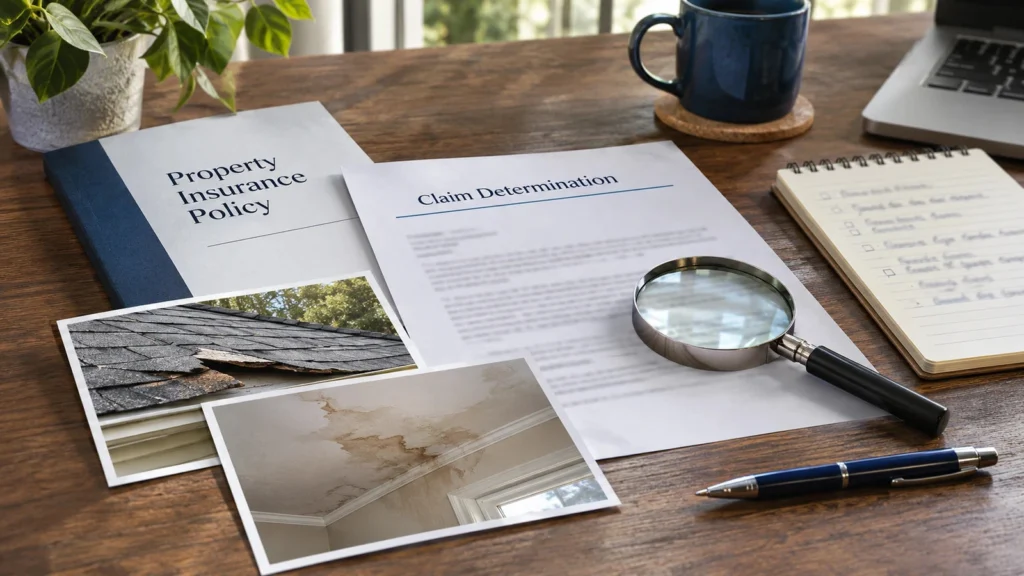
If an insurance claim for damage to your home or business has been denied, the immediate concern is often how to get the insurance company to reconsider. Before pursuing that, though, there is a more fundamental question: does the available information support the denial?
A property insurance claim may be denied for legitimate reasons. It may also be denied because of incomplete information, an incorrect factual assumption, a disputed technical finding, or a policy interpretation that deserves further examination.
Neither a denial letter nor substantial property damage, by itself, establishes whether the insurance company’s decision is correct.
Understanding this distinction is the first step toward a meaningful claim review.
Insurance Claim Denied: What Has Actually Been Denied?
Property insurance claims are not always accepted or denied as a whole. A single loss may involve several coverage provisions, multiple damaged components, different causes of damage, and various types of expense.
An insurer may accept one part of a claim while declining another.
For example, an insurance company may recognize fire damage to a building but decline certain environmental remediation expenses, dispute whether personal property needs to be replaced, or question whether continued displacement is related to the insured loss.
These are separate determinations, even when they stem from the same event.
It is also important to distinguish among several possible claim outcomes:
- A complete denial of coverage for the reported loss.
- A partial denial involving particular damage, property, or expenses.
- A disagreement concerning the extent or cost of covered repairs.
- A covered loss valued below the applicable deductible.
- A determination that remains pending because additional investigation or documentation is required.
Each presents a different problem and may require a different response.
Our article on insurance claims that close without payment examines why the absence of an insurance payment does not necessarily establish that coverage was denied.
Why Property Insurance Claims Are Denied
Insurance policies are contracts that include coverage provisions, definitions, exclusions, conditions, limitations, and endorsements. Coverage determinations depend on how these provisions apply to the circumstances of a loss.
Several issues commonly arise when property insurance claims are denied.
The reported cause of loss is excluded
Insurance doesn’t cover every condition that can damage a building.
Ordinary deterioration, maintenance-related issues, certain types of water intrusion, earth movement, and other causes of damage may be excluded under a particular policy.
For example, standard homeowners policies typically don’t cover surface flooding. Separate flood insurance may be available.
The key question is not just whether the policy includes an exclusion, but whether that exclusion applies to the documented facts of the specific loss under the policy as a whole and applicable law.
The cause of damage is disputed
Determining the cause of property damage is not always straightforward.
Consider a roof that starts leaking after a severe storm. The property owner attributes the damage to wind or hail, while the insurer concludes that it resulted from deterioration, installation deficiencies, or long-term exposure.
Storm damage and pre-existing deterioration may both be present.
Determining whether the observed conditions resulted from a specific event may require examining the roofing materials, historical photographs, weather records, maintenance history, installation details, and other available evidence.
A contractor’s recommendation to replace the roof does not, by itself, establish that a covered event caused the damage. Similarly, an aging roof does not necessarily mean it sustained no new storm-related damage.
The technical findings and policy provisions must be evaluated separately before their relationship can be understood.
The insurer disputes when the damage occurred
The date damage is discovered is not necessarily the date it occurred.
Water intrusion, concealed structural damage, and other developing conditions may go unnoticed for a long time. Different insurance policies may have been in effect during that period.
Historical photographs, inspection records, prior repair documentation, weather information, and a reliable chronology may be important when the timing of damage is disputed.
A date entered on a claim form does not replace an investigation into when and how the damage developed.
The insurer identifies an unmet policy condition
Property insurance policies may require the insured to give timely notice, prevent further damage to the property, cooperate with the investigation, provide requested documentation, or meet other duties after a loss.
An insurer may cite an alleged failure to meet a policy condition as grounds for denying coverage.
Whether that position is supported depends on the specific condition, the circumstances of the alleged failure, and applicable law.
For example, a delay in reporting a loss may raise different issues depending on when the damage reasonably became apparent and whether the delay affected the insurer’s ability to investigate.
These questions should not be decided based on assumptions. If the legal consequences of an alleged failure to meet policy conditions are disputed, qualified legal counsel should evaluate the matter.
What a Denial Letter Should Help You Understand
A denial letter communicates the insurance company’s position. Its usefulness depends on whether the reader can follow the reasoning behind that position.
A meaningful review generally begins with four questions:
- What damage, coverage, or expense is being denied?
- What policy provisions is the insurance company relying upon?
- What factual or technical findings support the determination?
- How do those findings relate to the cited policy provisions?
If the determination was communicated verbally, obtaining a written explanation can help preserve a reliable record of the insurer’s position. The National Association of Insurance Commissioners recommends requesting written confirmation when an insurer denies any portion of a homeowners insurance claim. Specific requirements for denial communications vary by jurisdiction.
A lengthy letter with numerous policy quotations may still leave important factual questions unanswered. Conversely, a relatively brief letter may convey a straightforward, supportable coverage determination. The objective is not to measure the length or complexity of the denial letter. It is to understand the reasoning.
The Policy and the Evidence Must Be Reviewed Together
An insurance claim cannot be adequately evaluated based on the denial letter alone. The relevant policy is the one applicable to the loss, including its declarations, coverage forms, endorsements, exclusions, definitions, and conditions. A declarations page may establish certain coverages and limits, but it does not contain every provision that determines whether a particular loss is insured.
Similarly, an exclusion quoted in correspondence should be considered in the context of the complete policy, not as an isolated paragraph. The other half of the review concerns the evidence.
An insurer’s conclusion may depend on an inspection, an engineering report, a laboratory finding, photographs, maintenance records, weather information, statements from the insured, or other documentation. The existence of that material does not necessarily establish that every conclusion drawn from it is correct.
Examine the investigation behind the conclusion
A useful technical review considers what was inspected, what was not inspected, the information available to the investigator, the methods employed, and the limitations identified in the resulting report. An engineering report addressing structural movement may not establish whether environmental contamination exists elsewhere in the building. A visual inspection of accessible surfaces may not resolve conditions within concealed assemblies. A weather report may establish that a storm occurred in the surrounding area without establishing that a particular building sustained damage during that event.
These limitations do not automatically invalidate the investigation. They identify the questions the available evidence can and cannot answer.
Consider evidence that supports the insurer’s position
An objective review should also consider information that weakens the property owner’s position. Prior photographs may document an existing condition. Earlier repair records may identify a recurring problem. An independent inspection may substantiate deterioration rather than new physical damage. Such information should not be disregarded merely because it is unfavorable to the claim.
A credible challenge to an insurance determination must account for contrary evidence. Otherwise, the review risks becoming an exercise in finding support for a conclusion already selected.
A Larger Repair Estimate Does Not Necessarily Overcome a Denial
One significant misunderstanding in disputed property claims is the belief that obtaining a higher repair estimate will prove the insurer should pay. A repair estimate outlines proposed work and its cost. It does not, by itself, establish what caused the damage, when it occurred, or whether the policy covers it. For example, a contractor may prepare a $40,000 proposal to replace a deteriorated roofing system. The proposal may accurately reflect the replacement cost.
But if the insurer denied the claim after concluding that no storm-related damage occurred, the higher estimate does not necessarily address the reason for the denial. The unresolved issue is causation, not simply price.
By contrast, if the insurer accepts that storm damage occurred but recognizes only a small portion of the necessary repairs, a well-supported estimate reconciliation may be directly relevant. This distinction is examined further in our article on scope, quantity, price, and methodology as different estimate disputes.
The additional evidence should address the actual reason for the insurer’s determination.
What Information May Support Further Review?
The documentation needed to evaluate a denied claim depends on the reason for the denial.
Records that may be relevant include:
- The complete insurance policy applicable to the loss.
- The written denial and related correspondence.
- Original photographs and video recordings.
- Insurance company estimates and inspection findings.
- Engineering, environmental, roofing, or other specialist reports.
- Historical photographs, maintenance records, and prior repair documentation.
- Contractor estimates, invoices, and supporting measurements.
- A chronology of the loss, inspections, communications, and material decisions.
Preserving original documents and their dates is especially important when the property’s condition has changed since the initial investigation. Necessary emergency measures should not be postponed solely to preserve evidence. Safety and reasonable protection against further damage remain important. When conditions must be altered, photographs, records of the work, and communication with the insurer may help preserve information that would otherwise be lost.
Additional guidance is available in our article on documenting property damage during an insurance claim.
The value of the documentation is determined by its relevance and reliability, not the number of pages submitted.
Can an Insurance Company Reconsider a Denied Claim?
A denial does not necessarily end consideration of a claim. An insurer may reconsider its position if new information becomes available, a factual error is found, a policy provision was overlooked, or a previously unresolved technical question is addressed. However, reconsideration does not necessarily mean the denial will be reversed.
A further investigation may confirm the original determination. It may also establish coverage for only a portion of the previously denied damage. A useful request for reconsideration identifies the specific determination being questioned, the reason for the disagreement, the supporting information, and the issue requiring further evaluation. Repeating the original claim submission without identifying what has changed may accomplish relatively little.
Property owners should also distinguish an insurer’s internal reconsideration process from any formal appeal, mediation, appraisal, or legal procedure. These mechanisms are not interchangeable, and their availability varies.
A Denied Claim May Involve More Than One Deadline
Property insurance disputes can involve several independent time requirements. These may concern notice of loss, submission of a proof of loss, supplemental documentation, completion of repairs, recovery of replacement cost benefits, contractual dispute procedures, or commencement of legal action. The applicable requirements depend on the policy, jurisdiction, and particular type of insurance. Federal flood insurance, for example, has its own dispute procedures and filing requirements administered through the National Flood Insurance Program. Those procedures should not be assumed to apply to an ordinary homeowners insurance claim.
Importantly, a request for reconsideration, a continuing investigation, or an insurance department complaint should not be assumed to suspend or extend any applicable deadline.
Qualified legal counsel should evaluate material limitation periods and other legal deadlines, particularly when a substantial claim has been denied or significant time has already elapsed.
Which Professional or Dispute Resolution Process May Be Appropriate?
The appropriate next step depends on what must actually be resolved.
Public adjusters and claim consultants
A licensed public adjuster may assist a property owner in documenting and presenting a claim, developing a supportable repair scope, evaluating claim records, and communicating with the insurer within the scope of the authorized engagement. A defined consulting assignment may be useful when the immediate need is to examine a specific technical question rather than to undertake full claim representation.
Neither role replaces qualified legal counsel nor guarantees that a denied claim will be accepted.
Engineers and other technical specialists
When the disagreement concerns the cause, extent, or physical characteristics of damage, a suitably qualified specialist may be necessary. The appropriate discipline depends on the question. A structural engineer, environmental professional, roofing specialist, or another qualified investigator may address different aspects of the same loss.
The assignment should be defined by the unresolved technical issue rather than a predetermined desired conclusion.
Insurance appraisal
Appraisal is primarily an amount-of-loss mechanism under applicable property insurance policies. It may address certain disagreements concerning damage, repair scope, and valuation, depending on the policy language and governing law. It is not a universal procedure for reversing a coverage denial.
Our article on what insurance appraisal actually resolves explains the importance of distinguishing valuation questions from legal coverage disputes.
State insurance regulators
A state insurance department may investigate complaints about insurance company practices, claim communications, delays, denials, or compliance with applicable insurance requirements. The department’s authority varies by jurisdiction. A regulatory complaint may help obtain a clearer explanation or identify a compliance problem, but the regulator may not have authority to resolve every disputed factual, technical, contractual, or legal issue.
The National Association of Insurance Commissioners provides information on filing complaints and locating the appropriate state insurance department.
Qualified legal counsel
If the main dispute involves interpreting the policy, whether an exclusion or condition is enforceable, legal deadlines, or possible legal remedies, an attorney with experience in property insurance may be the right professional to consult.
Our article on the different roles of public adjusters and attorneys provides additional guidance on that distinction.
When Further Pursuit May Not Be Justified
Not every denied insurance claim warrants an extensive investigation or professional engagement. The policy may clearly exclude the reported cause of loss. The available evidence may support the insurer’s findings. The amount reasonably in dispute may not justify the anticipated costs of additional investigation, professional fees, or formal dispute resolution. These possibilities merit consideration before substantial resources are committed.
Conversely, a significant loss involving incomplete investigations, conflicting technical findings, or unresolved policy questions may warrant a more detailed examination. An effective preliminary review should help determine whether a meaningful dispute exists, what information is missing, and whether further work is proportionate to the issue.
The objective is not necessarily to turn every denied claim into a contested claim. It is to establish whether there is a sound factual and contractual basis for further consideration.
Frequently Asked Questions About Denied Property Insurance Claims
Begin by identifying exactly what was denied—whether the insurer rejected the entire loss, declined a specific component or expense, valued the covered repairs below the deductible, or left the decision pending for further documentation. Request a written explanation if the decision was delivered verbally, then review the complete policy alongside the inspection findings, photographs, and specialist reports to verify whether the facts actually support the stated reason for denial.
No. A contractor’s repair proposal outlines proposed work and pricing, not what caused the damage, when it occurred, or whether the policy covers it. If an insurer denied a claim because it concluded that wear and tear rather than a covered storm caused the damage, submitting a larger replacement estimate does not resolve the underlying causation dispute.
Yes. An insurer may reconsider a denial when new evidence is presented, a factual error is identified, an overlooked policy endorsement is brought forward, or an unresolved technical question is answered. An effective reconsideration request targets the specific determination in dispute and explains what has changed rather than simply resubmitting the original claim package.
No. Property policies and state laws impose independent deadlines for proof-of-loss submissions, repair completion, replacement-cost recovery, and filing suit—and neither an internal reconsideration request nor a state insurance department complaint should be assumed to extend those time limits. Qualified legal counsel should evaluate applicable limitation periods whenever a substantial claim is denied or significant time has passed.
The appropriate professional depends on the specific issue in dispute. A licensed public adjuster or claim consultant can evaluate repair scope, documentation, and valuation; an engineer, environmental specialist, or roofing investigator addresses physical causation and damage characteristics; and qualified legal counsel evaluates policy interpretation, disputed exclusions or conditions, and legal deadlines.
Sources and further reading
- Understanding Your Homeowners or Renter’s Policy — National Association of Insurance Commissioners
- What You Need to Know When Filing a Homeowners Claim — National Association of Insurance Commissioners
- What You Should Know About Settling a Homeowners Insurance Claim — National Association of Insurance Commissioners
- How to File a Complaint — National Association of Insurance Commissioners
- Appealing a Flood Insurance Claim — FEMA National Flood Insurance Program
Related guidance
Absolute Adjusting approaches disputed property claims by examining the applicable policy provisions, documented damage, technical findings, estimates, correspondence, and unresolved factual questions.
Our public adjusting services may be appropriate for property owners requiring claim representation within jurisdictions where we are authorized to act. Our claim consulting services may be appropriate when a more limited technical review is needed before determining whether further professional involvement is justified.
Not every denial is incorrect, and not every disagreement requires a larger professional engagement.
Understanding the decision should precede deciding how to challenge it.