
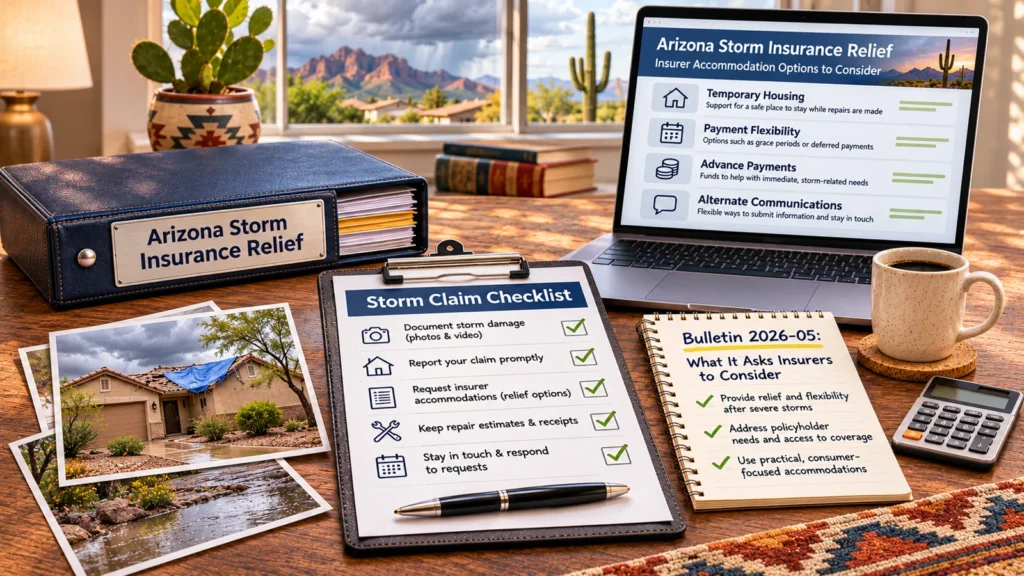
After the October and November 2026 severe weather, Arizona urged insurer flexibility. A regulatory request is not an automatic policy change.
The immediate answer
On November 3, 2026, the Arizona Department of Insurance and Financial Institutions (DIFI) issued Bulletin 2026-05 after emergency declarations on October 30 and November 2. The bulletin asks insurers serving storm-affected areas to consider temporary relief for customers affected by heavy rain, high winds, flooding, and tornado damage. It is a call for flexibility, not a blanket order granting every accommodation to every policyholder. For a homeowner or business owner facing repairs, displacement, or an approaching claim deadline, the next step is to ask the insurer for the specific accommodation needed and to obtain its response in writing. Do not assume a deductible disappeared, a proof-of-loss deadline moved, or coverage was expanded simply because the bulletin was issued.
What the Arizona bulletin actually requests
For property and casualty insurers serving residences or businesses in affected areas, DIFI encourages providing relief over the next ninety days. The listed measures include grace periods for premiums, postponing cancellations or nonrenewals, waiving deductibles, promptly addressing eligible Additional Living Expense requests, and extending certain claim-reporting and information-response requirements. The bulletin also asks insurers to consider allowing more time for insureds to replace damaged property under applicable replacement coverage, to provide policy copies upon request, to suspend certain fees related to temporary inability to pay premiums, and to accommodate difficulties in providing proof of loss. These are separate requests. An insurer may address one without addressing another, and any agreed extension should be identified by its actual start and end dates and the affected policy provision. The same bulletin states that insurers must continue to handle claims within regulatory timeframes. Its discussion of customer-relief programs does not promise that every insurer will grant every requested accommodation. The actual insurance contract and the written carrier response remain essential.
Ask the question that fits your loss
If you are displaced, ask how Additional Living Expenses apply to your situation and what receipts or housing documentation the carrier requires. If mail, utilities, or roads are disrupted, explain how this prevents timely submission of a document and request a specific written extension. If you cannot locate the policy, ask for the complete form and endorsements, not just a declarations page. For a replacement-cost claim, identify the specific deadline you are concerned about and ask whether the insurer will extend it, for how long, and under what conditions. For premium or deductible relief, ask whether the carrier has adopted a program for affected insureds and obtain the eligibility terms. A regulator asking insurers to waive deductibles is not the same as a deductible waiver in a particular claim.
Storm damage and flood coverage are separate questions
A severe storm can cause multiple types of damage. Wind-related roof damage, rain entering through an opening, overland surface water, sewer backup, and floodwater from a watercourse may involve different policy provisions. The bulletin does not add flood coverage to a homeowners or commercial property policy that lacks it. Identify how water entered and preserve photographs before cleanup alters visible conditions. Keep a safe record of damaged rooms, water levels, roof openings, debris, and work performed. Document the discovery date and retain invoices for reasonable emergency protection. Do not enter unsafe buildings, operate wet electrical equipment, or delay urgent hazard control to take more photographs.
Keep one written trail, not repeated requests
A short communication can identify the claim number, location, the specific hardship caused by the storm, the requested accommodation, and the affected document or deadline. Record the carrier’s response and any conditions. If the insurer declines, request its explanation rather than assuming the bulletin itself establishes a violation. When the underlying loss involves mixed or disputed causes, keep the coverage question separate from the temporary accommodation request. A policyholder can request additional time to submit documents without asserting that a policy excludes or covers a loss that has not yet been investigated.
The bottom line
Arizona’s Bulletin 2026-05 gives affected property owners a concrete reason to ask their insurer for flexibility during recovery. It does not replace the operative policy, confirm coverage, or automatically extend a deadline. Ask for the specific relief that matters, retain the written response, and keep the damage and expense records organized.
Sources and further reading
- Arizona DIFI, Bulletin 2026-05 (INS), Extreme Weather and Insurance Customer Relief; Flexibility, November 3, 2026
- Arizona DIFI, insurance consumer services and complaints
- Absolute Adjusting, Surface Water Flooding: Why Ordinary Property Insurance May Not Respond
Related guidance
For Arizona property owners dealing with a substantial storm-related insurance claim, our public adjusting services can assist with documenting the damage, evaluating repair estimates, and managing the claim.