
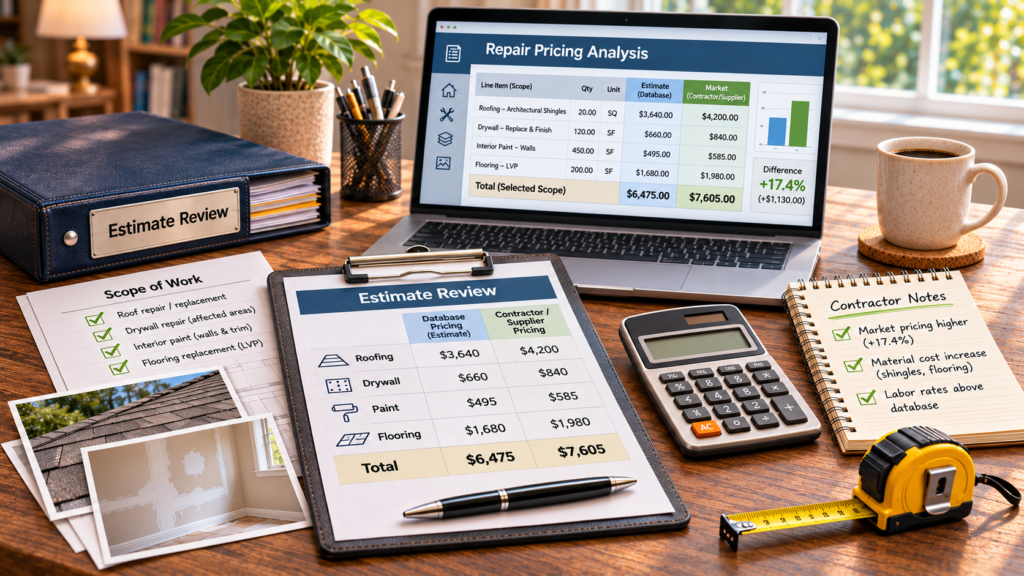
A detailed estimate can be calculated correctly and still misdescribe the work or the price required to complete it. The evidence matters more than the appearance of precision.
The immediate answer
Xactimate is useful for organizing a repair estimate into quantities, units, descriptions, and calculated amounts. The arithmetic can be exact. That does not establish that the estimate includes all necessary operations or that the selected prices reasonably reflect the particular job. The distinction is between precision and accuracy. A line that correctly multiplies a quantity by a unit price is mathematically precise. Whether the quantity describes the actual work, the line item includes the right activities, and the unit price fits local project conditions are separate questions. A polished estimate is a starting point for evaluation, not a substitute for it.
What Xactimate does well
The program provides adjusters, contractors, and reviewers with a common framework for describing work. Line items can identify demolition, installation, finishing, labor, materials, equipment, and other activities. Measurements and quantities can be compared across estimates. Properly selected line items make it easier to isolate disagreements rather than arguing only about the bottom-line total. Verisk, the publisher of Xactimate pricing, conducts pricing research using industry surveys, supplier information, and completed estimate transactions. Its published price lists are organized by local markets and updated regularly. That is meaningful market research, not an arbitrary price typed into a spreadsheet. It deserves consideration, and a reviewer should not dismiss it merely because a contractor has a higher bid.
Why the published number is not a ceiling
Verisk’s own Pricing Research Methodology notes that published information may not fit every contractor, repair, or structure. The company recognizes that building size, complexity, location, accessibility, company overhead, and service level can vary. It also offers methods for reviewing and adjusting costs when a project differs from the typical scenario represented by a published item. A database cannot account for every detail of an older building, remote driveway, occupied property, difficult ceiling, or post-catastrophe labor market. It may provide a useful regional starting point, while a particular job may require different methods, additional equipment, or specialty labor. Likewise, a contractor may include elective upgrades or a broader scope than the covered repair calls for. A disagreement over market pricing should be supported, not assumed either way. The relevant question, then, is not whether an estimate uses Xactimate, but whether its scope and prices hold up when measured against the work to be done.
Scope first: missing work cannot be fixed by precise pricing
Start with the operations. Does the ceiling repair account for access, protection of surrounding areas, removal, debris handling, installation, finishing, and the actual work sequence? Where needed, are detach-and-reset tasks, equipment, minimum labor charges, inspections, permits, and material-specific requirements included? The distinction between choosing a similar available line item and omitting necessary work is fundamental. A reasonable substitute may describe the right operation even when the database has no exact match. An omitted operation is not made up for by accurate dimensions on the remaining line items. On the other hand, the selected assembly may already include a cost, so adding it again would overstate the estimate. Compare each disputed item by location, activity, quantity, unit, material, labor, equipment, and sequence before addressing the unit price. Comparing totals alone skips the information needed to explain the differences.
Contractor cost, selling price, and insurance valuation are not identical
A contractor may negotiate discounts from suppliers or subcontractors, but those discounts do not automatically determine the retail price charged to the customer. For example, a painting company may buy coating materials for less than it charges its customer. How a discount is treated depends on the contractor’s agreement, which may be fixed-price, cost-plus, or another arrangement. Likewise, a subcontractor’s proposal, final invoice, general contractor’s price, and insurance replacement-cost estimate address different questions. A proposal does not prove that all the proposed work was completed or that the full amount was invoiced. Nor does a discounted invoice, by itself, establish what a qualified contractor should charge a property owner. If the work is represented as completed, the documentation should accurately state what was finished, billed, or remains outstanding. A common convention in insurance-restoration estimates is to include separate allowances of 10 percent for overhead and 10 percent for profit. This is not a universal measure of a construction business’s actual overhead, profitability, or reasonable selling price, and not every estimate warrants automatically applying those percentages. Before adding or removing general contractor overhead and profit, review what the line-item pricing already includes and consider the nature of the work.
How to support a price or scope supplement
A useful supplement identifies a specific operation and explains why the existing estimate does not adequately describe or price it. Supporting evidence may include photographs, measured quantities, a contractor’s quotation outlining its scope and exclusions, product specifications, actual project conditions, labor availability, or comparisons with other competent local proposals. Two contractor proposals may differ because one includes work the other excludes, the materials or work sequence differ, or the contractors use different business pricing. A higher quotation alone does not prove that the insurer underpaid. First reconcile the work being compared and the applicable policy conditions. When prices are disputed, identify the estimating database region and month used, and whether the work is expected to be performed under materially different conditions. If proposing an alternative line-item price, identify the supporting evidence and adjustment method. A supported discrepancy is more useful than an unsupported percentage increase.
Questions worth asking before accepting the total
- Does the estimate include every operation necessary to complete the stated repair, or are material tasks missing?
- Do the line-item definitions, units, quantities, and material selections match the actual building?
- Which region and date of pricing were used, and do project conditions justify another price?
- What does the contractor’s proposal include or exclude, and what is complete versus still proposed?
- How were overhead, profit, taxes, allowances, depreciation, and any separate policy benefits handled?
A policyholder need not master estimating software to ask these questions. The key is getting a clear explanation of the work and the evidence behind the claimed price.
The bottom line
Xactimate can be an effective tool for scoping and comparing estimates. Greater precision improves auditability, but the system cannot independently verify the underlying materials, labor assumptions, required operations, or market conditions. Neither the insurer’s estimate nor the contractor’s estimate is correct simply because it was entered into the system. A defensible review explains what work is required, how the estimate accounts for it, which prices are supported, and what remains uncertain. Absolute Adjusting provides defined estimate and claim-analysis services when authorized. It does not direct construction, guarantee a specific settlement amount, or override the policy language that governs payment.