
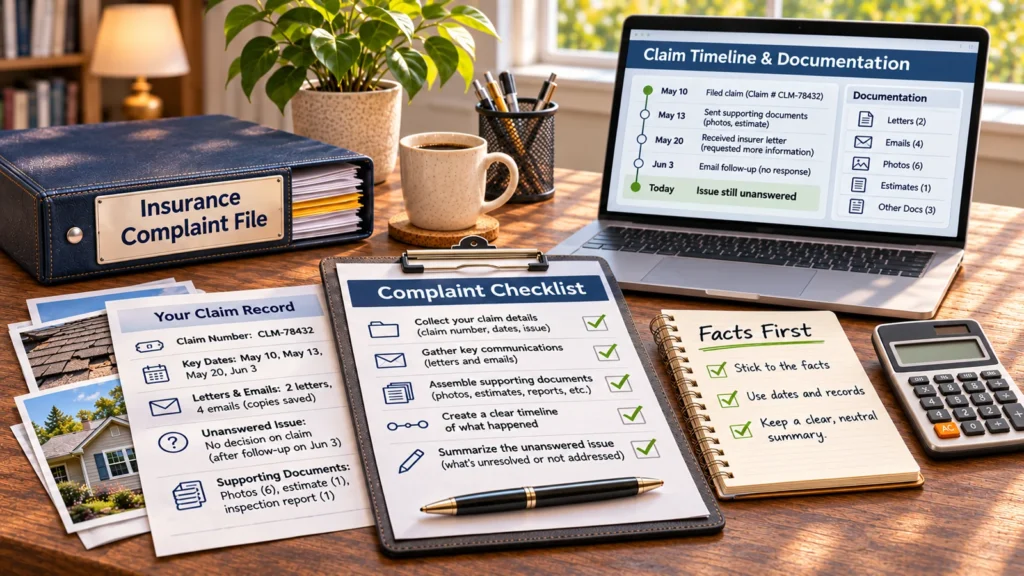
Dates, documents, payment status, and a specific unresolved question are more useful than lengthy accusations or unverified legal claims.
The immediate answer
An insurance complaint should tell the regulator what happened, what the insurer said or did, what remains unresolved, and where supporting documents can be found. A long narrative may feel satisfying, but it is not a substitute for a verifiable chronology and the actual policy and claim records. Colorado’s Division of Insurance (DOI) reported $15,803,329 recovered for consumers during its July 2025–June 2026 fiscal year, including $9,943,823 from property and casualty complaints. This is a statewide annual result, not a prediction of what any individual complaint will recover. The same October 28, 2026, announcement warned that AI-generated complaints can contain serious errors about policy provisions and state law.
Start with the exact issue
“The company has not paid my claim” can mean several things. Was coverage denied in writing? Was a check issued but not received? Is the draft payable to a lender or another joint payee and therefore not accessible? Is recoverable depreciation awaiting documentation of replacement? Or did the carrier omit an item from its estimate? Those questions require different answers. State the specific unresolved matter at the outset. For example, identify the disputed repair operation, the two conflicting written payment figures, or the question regarding a denied coverage item. Include the claim number and the date of the latest carrier response. A regulator should not have to search through a hundred pages to determine which decision is being challenged.
Use a short chronology and the actual documents
Build a chronological sequence from records you can identify: the loss notice, inspection, submitted estimate or inventory, carrier decision, payment letter, requests for clarification, and any response. Use the date shown on the original communication. If you remember a conversation but it isn’t documented, identify it as a recollection rather than quoting it as a written statement. Then select only the exhibits that support the central issue. The declarations page may show limits, but an endorsement or policy condition may be needed to explain coverage. A payment letter may show issuance, while the check, bank record, or lender communication addresses receipt and access. A contractor proposal is evidence of proposed scope, not automatically proof that work was completed and paid.
Describe the disagreement without declaring a legal violation
The most effective factual statement is often simple: “On October 10, I asked for an explanation of the $4,200 difference between these two estimates. The November 1 response did not address the listed items.” This is an illustrative example, not a real claim. It identifies an unanswered question without speculating on why the carrier acted as it did. Avoid alleging that conduct was intentional or unlawful without appropriate support and legal review. A regulator can examine matters within its authority, but a complaint does not replace counsel, appraisal, or compliance with policy deadlines. State rules vary.
Use drafting tools carefully
Software can help organize dates and correspondence. It cannot verify an unseen policy or an unreceived payment. Colorado DOI cautioned that AI-generated complaints can contain errors about policies and laws, causing delays. Arizona DIFI likewise advises consumers to verify factual and legal statements before submitting. If a drafting tool suggests a statute, regulation, policy exclusion, or deadline, open the controlling source before including it. Remove any legal citations you cannot verify. It is better to state what the insurer wrote and what remains unanswered than to fill the complaint with legal conclusions unrelated to the actual issue.
Be precise about the requested resolution
Tell the regulator what you want reviewed: a written coverage explanation, missing payment history, a disputed estimate line, or an unanswered submission. Do not assume that every amount claimed is due. Retain your submitted documents and the complaint reference number. Before filing, confirm the regulator’s jurisdiction and submission rules, and use the insurer’s claims channel when appropriate. Preserve all applicable deadlines, and consult counsel regarding legal questions or an expiring remedy. Filing a regulatory complaint does not automatically extend those deadlines.
The bottom line
A well-organized complaint is easier to assess and less likely to be misunderstood. Identify the unresolved issue, list the dates, clarify what was issued and what was received, include the documents, and ask a specific question. Accuracy matters more than volume.
Frequently Asked Questions About Filing a State Insurance Regulatory Complaint
An effective regulatory complaint clearly identifies the claim number, the date of the insurer’s latest response, the specific unresolved dispute—such as a denied coverage item, an omitted repair operation, a missing payment, or an unexplained estimate discrepancy—and a concise chronological timeline backed by the actual policy and claim records. Focusing on verifiable dates, payment status, and unanswered questions allows the regulator to review the issue without sorting through an unfocused narrative.
Attach only the specific exhibits that directly support the disputed issue, such as the policy declarations page and relevant endorsements, the insurer’s written coverage determination or payment letter, conflicting repair estimates, and written requests for clarification alongside the carrier’s responses. When referencing a telephone conversation that was not confirmed in writing, explicitly label it as a recollection rather than presenting it as a verbatim written record.
State insurance regulators—including the Colorado Division of Insurance and the Arizona Department of Insurance and Financial Institutions—have cautioned consumers that AI-generated complaint drafts frequently contain inaccurate citations to statutes, regulations, and policy provisions, which can delay review. While drafting software can help organize dates and correspondence, policyholders should verify every statute, policy exclusion, and factual statement against the controlling documents before submitting.
Rather than declaring that an insurer’s conduct was intentional, unlawful, or bad faith without legal review, state the objective facts—for example, identifying the exact date a written question was submitted and noting what the insurer’s response failed to address. A state regulator can examine administrative and claims-handling matters within its statutory authority, while legal conclusions, statutory remedies, and policy interpretation belong with qualified legal counsel.
No. Filing a complaint with a state department of insurance does not automatically extend contractual suit-limitation periods, proof-of-loss deadlines, recoverable depreciation timeframes, or appraisal notice requirements. Policyholders must continue tracking and preserving all operative policy and statutory deadlines independently and consult qualified counsel whenever legal rights or expiring remedies are involved.