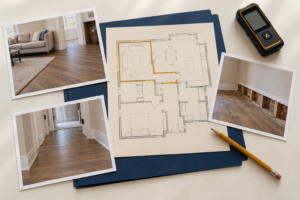
There is an adage in the claims business: whoever controls the scope controls the claim. Policyholders tend to fixate on the bottom-line number of an estimate. Claim professionals fixate on the scope, because the scope is where the number comes from.
The three elements of claim value
A property claim can be divided into three elements. The first is coverage: is this a covered cause of loss under the policy? The second is scope: which damaged elements are included in the claim? The third is valuation: what does the included scope cost to repair or replace? Those three elements combined determine the value of the claim, and they should be kept separate in the policyholder’s mind, because a dispute about one is not a dispute about the others. Valuation gets the attention because it produces the number. But on many contested files, the real distance between the carrier’s position and the policyholder’s position is scope. Large estimate differences are often driven by scope, quantities, sequencing, and omitted operations rather than unit price alone. Missing rooms, trades, quantities, and tear-out and detach-and-reset work account for far more of the difference. An estimate can be priced correctly and still fall short because it describes less work than the loss requires.
The inspection is where scope is set
When a loss is inspected, an adjuster evaluates damage with coverage in mind and scopes what the carrier regards as covered. A contractor generally focuses on the work required to repair the property rather than deciding insurance coverage. Both perspectives are useful. Neither is complete on its own. The practical consequence for the policyholder is simple: present everything at the inspection. Every area of damage, including damage that seems minor or inconsequential, should be shown to the inspecting adjuster and documented in the claim file. Ask that the adjuster photograph each condition raised, and keep a written note of what was pointed out and when. Damage that never enters the file at the beginning can be difficult to establish later, and supplements to add scope after the fact take longer than documenting the condition once, on the day, with the adjuster standing there. Presenting the complete scope is not inflation. The goal is an estimate that describes all of the work the covered loss actually requires, no more and no less. Presenting a complete scope early can reduce later supplement disputes and repair delays.
Matching, line of sight, and where scope disputes concentrate
One issue that appears constantly in scope disputes is matching, sometimes discussed as line of sight. Flooring runs continuously from a damaged living room into a hallway and bedrooms. Paint continues across connected walls. Roofing surrounds a damaged slope. The question is where the repair reasonably stops. Carriers often propose stopping at thresholds, doorways, and other natural breaks. Policyholders often argue that a repair that leaves visibly mismatched materials in a continuous area is not complete. The traditional framing of the question is reasonably uniform appearance: whether the repaired area, viewed as a whole, presents the appearance the property had before the loss. Some states address matching in regulation or published guidance, and some policies now speak to it directly through endorsements. Because the treatment varies by state and by policy form, matching is a place where the specific policy language and the applicable state’s rules must actually be read, not assumed in either direction. What the policyholder can always do is frame the issue factually: document the continuity of the material, photograph the transition points, and obtain the manufacturer or supplier information showing whether the existing material remains available. A matching position supported by product documentation is a scope argument. A matching position supported by preference is an aesthetic complaint. The two are generally received very differently.
Scope before price, every time
When an estimate arrives, the productive first read is not the total on the last page. It is the room list, the trade list, and the quantities. Is every damaged area represented? Is every trade the repair requires present, including the unglamorous ones such as content manipulation, tear-out, disposal, and detach-and-reset? Do the measurements match the property? Only after the scope is verified does comparing unit prices mean anything. A policyholder who disputes the bottom line is negotiating. A policyholder who documents missing scope is correcting the record. The second conversation goes better, and it is the conversation the claim file will support if the dispute ever moves to appraisal or another formal process.
Frequently Asked Questions About Property Claim Scope and Estimates
What is the difference between coverage, scope, and valuation in a property insurance claim?
Every property insurance claim rests on three distinct elements: coverage (whether the cause of loss is insured under the policy), scope (which damaged building components, rooms, and repair operations are included), and valuation (the dollar cost to repair or replace the included scope). Keeping these three elements separate ensures that missing repair activities are addressed as scope omissions rather than confused with unit-price disagreements.
Why does repair scope matter more than the bottom-line dollar total on an insurance estimate?
An estimate can use accurate unit pricing and balance mathematically while still falling short if it omits damaged rooms, required trades, tear-out, disposal, contents manipulation, or detach-and-reset work. Verifying the room list, trade list, repair sequence, and measurements first establishes the true physical work required before comparing line-item prices or totals.
What should a property owner do during the initial adjuster inspection to protect repair scope?
Walk the entire property with the inspecting adjuster and point out every damaged area—including minor or secondary conditions—asking the adjuster to photograph each item while keeping a dated written log of what was shown. Documenting the full physical scope at the initial inspection establishes a clear baseline in the claim file and helps reduce prolonged supplement disputes later in the repair process.
How are “matching” or line-of-sight disputes evaluated on continuous materials like flooring, paint, or roofing?
Matching disputes—such as whether continuous flooring, connected wall paint, or surrounding roof slopes must be replaced to maintain a reasonably uniform appearance—depend on specific policy language, matching endorsements, and applicable state regulations. Rather than framing the issue as personal aesthetic preference, policyholders can support a scope position factually by photographing material continuity and obtaining written documentation from the manufacturer or supplier showing whether the existing material is discontinued or unavailable.
What is the most effective way to review an insurance repair estimate when it first arrives?
Start at the beginning of the estimate rather than the summary page: verify that every damaged room or elevation is listed, confirm that room measurements match the property, check that all necessary preparatory and finishing trades are included, and cross-check any specialist recommendations. Documenting specific missing operations or inaccurate quantities turns a general negotiation over price into a factual correction of the claim record.