
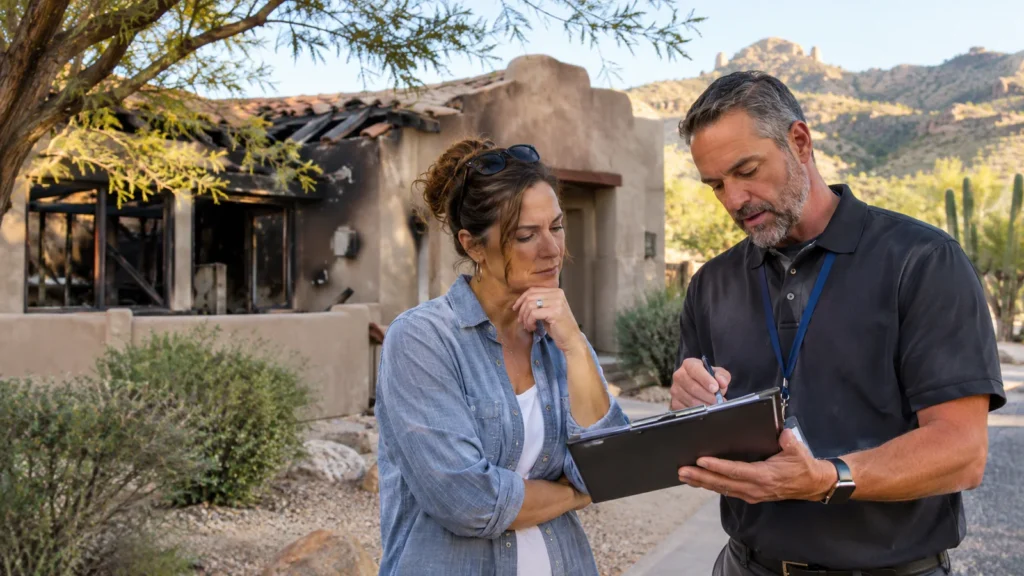
Property owners in Arizona searching for a public adjuster often face a decision they have not encountered before. Their home or business has sustained damage, the insurance claim is becoming increasingly complex, and they are trying to determine whether professional representation is necessary.
Not every property insurance claim requires a public adjuster. Many claims are resolved satisfactorily through routine communication between the insured and the insurance company. Other claims involve significant technical, financial, and administrative demands that property owners may not have the experience or time to manage effectively.
The decision to retain professional assistance should be based on the claim’s circumstances, the work required, and the anticipated value of that assistance.
What Does a Public Adjuster in Arizona Do?
A public adjuster represents an insured by investigating, documenting, presenting, and negotiating a property insurance claim, within the authority allowed by Arizona law and the professional engagement. The Arizona Department of Insurance and Financial Institutions distinguishes adjusters who represent insurance companies from public adjusters who represent insureds.
The distinction is about whom the professional represents; it does not necessarily reflect the individual’s competence, experience, or quality. Depending on the engagement, public-adjusting services may include reviewing claim records, inspecting property damage, preparing estimates, creating personal property inventories, reconciling insurance payments, identifying outstanding documentation requirements, and communicating with the insurance company.
A public adjuster does not create insurance coverage, remove policy exclusions, authorize construction on the owner’s behalf simply by preparing an estimate, or guarantee a particular settlement.
When Professional Representation May Be Appropriate
The loss is substantial or technically complicated
A major fire, water loss, wind event, or commercial property loss may involve multiple types of insurance benefits and a range of professionals.
The claim may require coordination of structural estimates, environmental investigations, contents inventories, mitigation records, additional living expenses, business income documentation, and payment accounting.
The challenge is not simply obtaining an estimate. It is establishing how the various records, findings, costs, and policy requirements relate to each other.
The scope of damage is disputed
An insurance company and a property owner may agree that an insured event occurred but disagree about the resulting damage or necessary repairs. For example, a carrier may acknowledge direct fire damage while disputing the extent of smoke contamination, the need to remove concealed materials, or whether certain contents can be restored. Resolving these issues may require qualified technical investigations and a carefully documented repair plan.
Professional assistance may be useful when an ordinary contractor’s estimate is not enough to address the disagreement.
The claim has become administratively difficult
A property owner may receive multiple estimates, revised payment summaries, documentation requests, and correspondence from different adjusters. Some documents may replace earlier versions, while others may cover separate categories of coverage. Without an organized record, it can become increasingly difficult to determine what has been submitted, what the insurer has accepted, what remains disputed, and what action is needed next.
Professional representation may help organize the claim record and identify the outstanding decisions needed to move the adjustment forward.
The property owner lacks the time or experience to manage the claim
A major property loss can bring responsibilities as complex as managing a business project. The insured may need to handle temporary housing, work, family obligations, choosing contractors, lender requirements, and the financial impact of the loss—all at once.
Hiring professional help may be appropriate even when the insurance company is communicating constructively. Representation can be valuable beyond contentious claims.
When Hiring a Public Adjuster May Not Be Necessary
A relatively straightforward claim, with identifiable damage, a reasonable repair estimate, clear policy provisions, and effective communication, may not warrant comprehensive professional representation. The amount reasonably in dispute also matters. If the unresolved difference is small, the expected cost of professional representation or technical investigation may outweigh the potential benefit.
In other cases, the property owner may need only an independent estimate review, a payment reconciliation, or help resolving a specific documentation issue.
A limited consulting engagement may be more appropriate than full claim representation.
Arizona Public Adjuster Licensing
Arizona regulates individuals and businesses engaged in insurance adjustment activities.
A.R.S. § 20-321 defines adjustment activities in the context of property and casualty insurance claims. A.R.S. § 20-321.01 sets the general requirement for adjuster licensure, subject to applicable statutory provisions and exceptions.
Before retaining someone to represent an Arizona property insurance claim, the insured should verify the professional’s current licensing status with the Arizona Department of Insurance and Financial Institutions.
The Department explains that individuals performing adjuster activities generally require their own appropriate licensing, even when working for a licensed business entity.
A business website, professional designation, out-of-state license, or statement of experience is not a substitute for verifying the required Arizona authority.
Licensing establishes regulatory eligibility. It does not establish experience with every type or level of complexity of property loss.
Public Adjusters, Contractors, and Attorneys Perform Different Roles
A contractor performs construction work, while a public adjuster assists with insurance claims and an attorney provides legal advice and representation. Although their work may involve some of the same documents and property conditions, their responsibilities are not interchangeable. A contractor can provide important evidence about repair feasibility, materials, labor, sequencing, and actual construction costs. A public adjuster may assess that information as part of the insurance claim. An attorney may be needed when a dispute primarily involves legal rights, policy interpretation, contractual enforceability, litigation, or significant limitation periods.
This distinction is especially important after widespread storm damage, when property owners may receive offers of repair services and claim assistance from numerous businesses.
Arizona’s licensing requirements and applicable limitations should be evaluated based on the actual services offered, not merely on the title a business uses.
Our article on Arizona’s SB1206 examines the distinction between insurance adjustment and construction activities in greater detail.
What to Ask Before Signing a Public Adjusting Agreement
A professional engagement should explain what work will be undertaken and the terms under which that work will be performed.
Useful questions include:
- Is the individual performing the work appropriately licensed in Arizona?
- What experience does the professional have with comparable property losses?
- Which portions of the claim are included in the engagement?
- How are fees calculated, and which insurance benefits are included in that calculation?
- How are previously issued payments treated?
- Who is responsible for the cost of outside technical specialists?
- How will claim records, correspondence, estimates, and payments be handled?
- What happens if the engagement is terminated before the claim is concluded?
Property owners should understand the written agreement rather than relying solely on descriptions from an initial conversation.
The lowest fee does not necessarily indicate the least expensive engagement, and a higher fee does not necessarily signal greater competence.
The relevant considerations include the work required, the services included, the financial terms, and the professional’s suitability for the particular assignment.
When During the Claim Should a Public Adjuster Be Retained?
There is no single point at which professional representation is right for every claim.
Early involvement may help when the loss is substantial, evidence could change quickly, or initial repair and restoration decisions may significantly affect how the claim develops.
Later involvement may be appropriate when the claim is difficult to reconcile or a significant disagreement has arisen.
However, engaging a professional late can bring additional challenges. Property may have been removed, repairs may have changed the original conditions, documents may be missing, and earlier decisions may have narrowed the available options. Retaining professional assistance does not necessarily reopen an expired deadline or undo an agreement already signed. A preliminary assessment should therefore establish the claim’s current status before the professional recommends an engagement.
The Decision Should Begin With the Claim, Not a Promise
A meaningful initial discussion should identify the loss, the available policy, the current insurer’s position, the documentation already developed, and the specific work the property owner needs. Sometimes the appropriate recommendation is comprehensive representation. Sometimes it is a defined technical review, assistance with personal property documentation, or consultation with qualified legal counsel. Sometimes the available information supports continuing the claim without additional professional assistance.
The objective should be to identify a proportionate professional response to the actual circumstances, rather than treating every claim as a larger engagement.
Frequently Asked Questions About Hiring a Public Adjuster in Arizona
A public adjuster is typically most helpful when a residential or commercial loss is substantial or technically complex, when the insurer disputes the scope of damage or repair methodology, when multiple estimates and partial payments make the claim administratively difficult to track, or when the property owner lacks the time or experience to manage the claim alongside recovery obligations. Straightforward claims with clear damage and a small amount in dispute often do not require full representation.
Under Arizona Revised Statutes § 20-321 and § 20-321.01, individuals performing adjuster activities generally require their own active Arizona license, even when working for a licensed business entity. Before signing an agreement, verify the individual adjuster’s current license status directly through the Arizona Department of Insurance and Financial Institutions (DIFI) license search rather than relying solely on a website, designation, or out-of-state license.
No. Contractors perform construction and repair work, whereas public adjusters represent policyholders in investigating, documenting, presenting, and negotiating insurance claims, and attorneys provide legal advice and representation. Their roles and licensing requirements are distinct under Arizona law, including the restrictions addressed in Arizona’s SB 1206.
Before signing, confirm that the specific individual handling your file is licensed in Arizona, ask about their experience with comparable losses, verify which coverages are included in the engagement, and clarify how fees are calculated, including how previously issued payments are treated, who pays for outside technical specialists, how records and settlement funds are handled, and what happens if the agreement is terminated early.
Early involvement can be advantageous on major losses where evidence may change rapidly or initial restoration choices affect claim development, while later involvement may still help organize and reconcile a stalled or disputed file. However, engaging a professional late can present challenges if damaged materials have already been removed, records are missing, or policy deadlines have passed, so a preliminary status review should come first.
Sources and further reading
Related guidance
Absolute Adjusting offers public-adjusting services for eligible residential and commercial property claims in Arizona, subject to licensing, availability, conflicts, and the circumstances of the proposed engagement.
A preliminary discussion can help determine whether comprehensive representation, a limited technical assignment, or another professional service best fits the claim.
The decision to retain a public adjuster should be guided by the work the claim actually requires.